Birregurra-Forrest Rail Trail


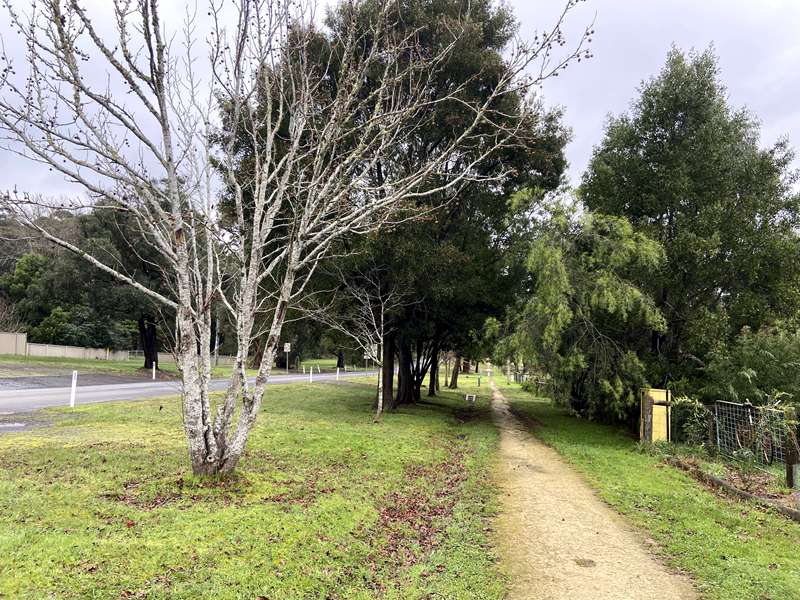
The Birregurra-Forrest Rail Trail or "Tiger Rail Trail" is a rail trail following the route of the former Forrest branch railway line
The overall plan for this trail is for it to start in Birregurra, meander along the old railway formation, through Deans Marsh, to the existing section near Barwon Downs and on to Forrest which will be a total length of 30 km.
Currently 7km of the trail is completed from the Forrest end.
The trail's "Tiger" name comes from the days when trains stopped running between the towns. A converted Dodge sedan, painted black and yellow, ferried passengers instead.
The trail begins in Forrest, across the road from the Forrest Hotel on Henry Street. The original railway station site can be seen 500m further south, down Station Street.
History
The Cape Otway Forest Railway opened on the 5th of June, 1891. The original stations along the way were Birregurra, Whoorel, Deans Marsh, Pennyroyal, Murroon, Barwon Downs, Gerangamete, Yaugher and Forrest.
Forrest, the terminus of the line, was originally known as Yaugher until it was changed to Forrest, after Charles Forrest, the local Member of Parliament responsible for having the line built. Prior to 1890 there was no settlement at Forrest so the township was a creation of the railway.
This sounded the charge for settlers, who under section 32 of the Lands Act 1884–90 took up their acreage for the great expense of tuppence an acre. Sadly the local lands department interpreted the Lands Act to mean that settlers had to clear their acreage of all timber, when in reality they were only permitted to clear dead or useless timber. The misunderstanding arose from the administration of Victoria's Land Act 1884, under which many Otway selectors held Section 32 grazing leases.
Forrest was the largest traffic generator on the line for passengers and outwards and inwards freight. Passenger loadings were the highest overall on the line. Inwards freight was general supplies for the area, stock fodder, chaff and hay for the sawmill horses and road gravel. Outwards general loading was agricultural produce, root crops and hops.
District Saw millers were heard to comment in 1899 that the value of the timber cleared "would have paid the national debt". The 1899 Royal Commission into the Management of State Forests found that settlement in the Otways was a great administrative blunder and that the majority of the land should be reserved for watershed purposes and for milling timber.
Rail facilities were the most elaborate on the line. There was a departmental residence, a four road layout, dead end siding for the split timber traffic, a siding for a locomotive turntable, a 60 metre passenger platform with office, parcels shed and waiting room, a goods platform, two goods sheds and a six tonne crane. The Post Office was operated from the railway station office for over fifty years, with the Postmaster also being the Station Caretaker.
Six timber tramways, in use from 1892 to 1939, delivered large quantities of sawn timber to the railhead from the bush to the south and west. Bullock wagons also conveyed timber by road and, after 1934, motor trucks performed this function. The sawmill companies built loading skids, store sheds and locomotive service facilities in the yard.
Timber loadings averaged 8,700 tonnes per year (almost 7,400 cubic metres sawn) from 1899 to 1950. The highest tonnages were despatched from 1901 to 1912 and 1938 to 1942, with peak years being 1905 handling nearly 15,000 tonnes (12,700 cubic metres sawn) and 1942 totalling almost 14,000 tonnes.
From 1947 two sawmills (Sharp's and Henry's) were established in the rail yard, and loaded their output direct into rail trucks until interruptions sent a large proportion via road transport.
Timber Tramways
A network of narrow-gauge tramways ran from timber mills deep in the bush into Forrest Station, where timber was loaded onto trains on the Tiger Railway. Before locomotives were ever used on tramways, horses pulled empty trolleys up to the mills and brought back heavy loads of timber. Pictured is a load on one of the many trestle bridges on the downhill run to Forrest. The horses are harnessed behind, as trolley drivers used an unreliable rope and lever brake system that pulled up wooden wedges onto the trolley wheels. Previously horses had been harnessed in front of loads of timber, but brake failures resulted in terrible accidents that killed men and whole teams of horses. It was safer to tether the horses behind, in order to save the team if the trolley broke away.
Clydesdales were bred in Barwon Downs to supply the timber industry with horse power. Teams of horses and bullocks were the backbone of the timber industry's success. Bullocks opened up the Otways and then horses were brought in to be the main source of transportation of people and products.
Location
Henry Street, Forrest 3236 View Map
Web Links
→ Birregurra - Forrest 'Tiger' Rail Trail (Railtrails.org)


