Beech Forest Walking and Driving Tour


Enjoy your walk through the Beech Forest township, let your imagination run wild as to what life was like in this area for First Nation people and those who settled on this land from 1884. This historic self guided tour takes you on a discovery adventure on Gadubanud country.
The History of Beech Forest
Once a booming community, with rapid development following the arrival of the railway in 1902, the town consisted of a number of shops, services and facilities. Beech Forest soon became the largest township in the area and the local government administrative and services centre by 1919.
The main industries and employment providers were potato, beef and dairy farming, logging and sawmilling and railways.
Several bushfires ravaged the area causing devastation from the years 1898 to 1939 and many of the timber buildings were destroyed. Improved road networks and sawmills moving out of the bush led to the closure of the railway in 1962. Following this, the town's population decreased substantially.
Today, a small yet vibrant community exists of those who have ancestral connections through to people new to the area enjoying a great lifestyle that this unique temperate rainforest region provides.
The many magnificent evergreen myrtle beech trees, Nothofagus cunninghamii in this area led to the naming of the township as Beech Forest.
Spot some fine examples along Main Road and Southorn Street, along with the native mountain pepper berry trees, a known food and medicinal source for Aboriginal people, and a culinary delight still harvested by many today.
Gathering places. Commence your walking tour here. Distances are approximate starting from Beech Forest Community Hall. Total walking time approximately 1 hour.
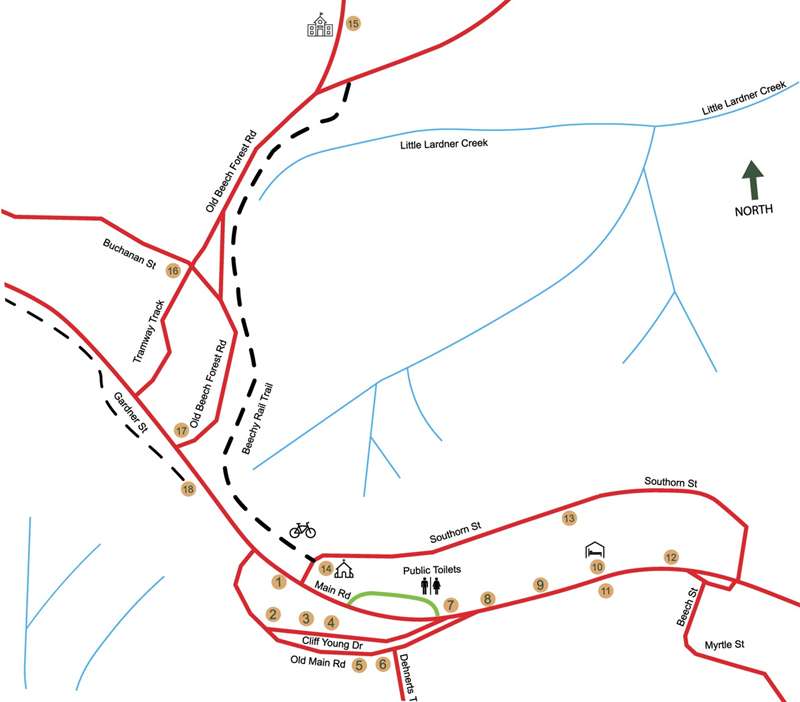
1. Cliff Young Boot Memorial - Albert Ernest Clifford Young (1922–2003), a potato farmer from Beech Forest, known for his Sydney to Melbourne Ultra Marathon record breaking win at 61 years of age. Cliff trained for the race by running in gumboots on his property in Beech Forest. His running style became known as the "Cliff Young Shuffle".
2. Beech Forest Community Hall - Built in 1921 featuring striking Baltic timber panel ceiling, stage, dressing rooms, ticket office and projection room (which are some of the unique features that remain today). It also housed the shire offices and the impressive council chambers which is now home to ODHS (Otway Districts Historical Society) history rooms featuring four permanent display rooms. The hall hosted balls, dances, music and movie nights, and provided a venue for societies and clubs to meet. This community meeting place tradition continues today.
3. War Memorial - A granite obelisk & honour roll sitting on locally quarried stone, erected in 1949 to commemorate the WW2 sacrifices of the district's residents. In 2006 a sandstone plinth was added to commemorate three RAAF airmen killed in a plane crash near Beech Forest in 1942. Artefacts from the wreckage can be seen in the ODHS history rooms along with WW1 honour boards. Today we can reflect on those who left Beech Forest to contribute to war efforts, and on the hardships faced by the women, children and others who struggled to maintain community and family life as they knew it.
Cliff Young Drive / Old Main Road – a historic centre of railway workers houses and shops
4. Along this road are original houses from Beech Forests' heyday. The Church of England, a blacksmith, Methodist Church and the station master's house were also located here.
5. Private hospital & consulting rooms / Post Office This 1905 building was originally the hospital, consulting room and residence for Dr Backhouse. In 1918 it became a post office providing full postal services to the Otway region operating until 1994. Note the telephone box on the right, circa 1950.
6. General Store - Established on this site in approximately 1914 being relocated from an earlier site, this store became the largest of its type in the area, remaining open until 1975, eventually demolished in 2004. Today you can see the remains of the petrol bowser; the bowser panels can be seen in the history rooms of the ODHS.
John W Gardner Reserve area – Main Road
7. This reserve extends to the commencement of Southorn Street to the west and includes a memorial stone commemorating John Gardner, a committed pioneer & first settler of the area who arrived in 1884 at the age of 23. Gardner was instrumental in establishing many town services and businesses. Another commemorative stone depicts the anniversary of the first Bush Nursing facility in Victoria. In this area you will see metal stencils depicting the railway, and a historic photographic display in the tourist information bay. The Police lock up, a fine example of a single cell timber lock up used as a temporary holding place, was originally located in the grounds of the police station on the corner of Old Beech Forest Road, then moved to the 2nd police station on Dehnerts Track before finally being relocated to this site.
8. Beech Forest railway station site - The arrival of the narrow gauge Colac to Beech Forest line was the most significant event in the town's history with the first train arriving on the 17th February 1902. In 1911, the line was extended to the west to Crowes which greatly benefitted the town's economy. The line closed on 30 June 1962.
9. The Beech Forest Butter Factory site - A successful butter factory operated here servicing approximately 50 local farms from 1902 to 1924. Today the factory well and some flooring (covered by the deck) are the factory's only remains. The building burnt down in 1937. The well has Victorian Heritage recognition as a site of historical significance.
Main Road / Southorn St
10. The Beechy Hotel continues the town's historic past as the hub of the Beech Forest community. Gardner's Ditchley Park Hotel obtained the first liquor licence in 1888, followed by the second hotel in 1914 of the same name, located closer to the railway station fronting Southorn Street. This hotel burnt down in 1961. The new hotel was built in the main street in 1963 before being remodelled in 1998 after a fire destroyed the bar and kitchen. Note the hand winch on display at the front of the hotel, an example of winches used at sawmills throughout the region.
11. Baker's residence and bakery site - The first bakery existed on the Gardner Hill area to the west and the second in Main Street built in 1930. The wood fired oven built in 1888 survived the 1939 bushfire that destroyed the building until another was constructed around the oven. In 1939 the baker's residence was built. The bakery was an important meeting place, offering warmth from the harsh weather conditions. The oven produced 140 loaves of bread 3 days a week until the store's closure in 1978. The oven has moved to different sites across the region and has now returned to Beech Forest, with plans underway for its resurrection.
12. Railway turning loop - Follow the loop and imagine the Colac and Crowes lines as they entered the Beech Forest yard from the same end, creating a junction where trains had to be turned in a balloon loop designed to reduce wear on the wheels of the narrow-gauge trains. Local families enjoyed playing tennis at the court constructed in the 1930s which was located in the centre of the loop.
13. Southorn Street was an alternative area for businesses and services that moved down from Gardner Hill. John Cockerill, Charles Buchanan and John Gardner, the three earliest settlers, became rival business owners providing land in a bid to develop more services and shops. Along with the second Ditchley Park Hotel, the Station Master's house still standing today, was also moved to Southorn Street from Main Street.
14. St Anselm Vicarage & Church - Of the many denominations once represented in Beech Forest, this church is the only one still providing services. Constructed in 1910 on Main Road, following the destruction of the original church on the Gardner Street site in 1908, the church was moved to this site in 1946. The old tower was relocated here from Port Fairy and first tolled in 1959. The vicarage, constructed in 1939, also became home to the Beech Forest pre-school in 1973 and is now the home of the Art Reach Gallery Café.
From St Anselm follow the Beechy Rail Trail to Old Beech Forest Road, crossing the road to the school.
Gardner Hill
15. Beech Forest School SS No. 3235 – 1570 Old Beech Forest Road Opening in 1909, and reaching its peak in 1911, when it was extended with the inclusion of a "gallery" of raised flooring. There was an attendance of 94 students, most of whom trudged long distances often through rain, hail and snow to attend. This was the second school, with the first opening in a room in the hotel in 1895. The enrolment dwindled to 7 in 1979, and it closed in 1980/81. From Buchanan Street you can see the original playground equipment in the back yard. Local legend has it that in 1949 a time capsule was placed in the school yard, yet to be discovered.
16. Tramway Track - Once the route of the horse drawn tramway connecting Ditchley Park Station to Gardner's Hotel and Buchanan Street to service shops and business in this area. On the left stands the solid red brick Catholic Church of the Immaculate Conception built in 1920. This Church replaced the Gothic style St Mary's which was destroyed by the 1919 bushfires.
Continue across Gardner Street and follow the path to the Beechy/Crowes Railway
17. Police Station - This building was constructed in 1903 and the first police house opened here in 1907, along with a single cell lock up in the backyard. A new station was built in 1912 on Dehnerts Track and was replaced on that same site in 1960 still standing today. The police storage unit is housed in the ODHS history rooms and contains some very interesting original police documents.
18. Beechy to Crowes Railway - A walking and cycling path from Beech Forest to Ferguson commemorating this 1911 pioneering route which ended at the southernmost railway terminus on the Australian mainland. This stunning bioregion, with a historic aqueduct takes you through a fern canopy to a magnificent panoramic vista of rolling hills and valleys through to the Southern Ocean. At night and with the right conditions you will see glow worms on the forest walls. A great way to conclude your tour.
* Private residence, please respect the owner's privacy.
Distances from the ODHS history rooms – approximately one hour with additional time for visiting waterfalls and picnic areas.
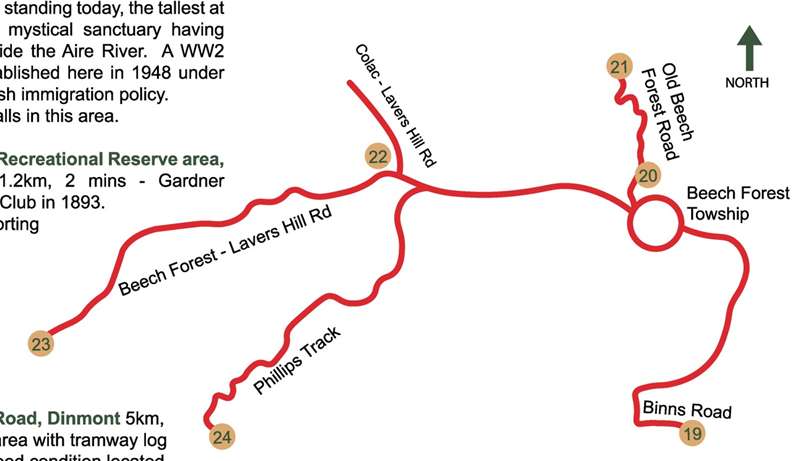
19. Displaced persons camp / Redwood Forest, Aire Valley 7 km, 12 mins south east, 15 mins easy walk – Located on the banks of the Heritage listed Aire River, Sequoia sempervirens were planted in 1936 with over 200 standing today, the tallest at over 60 metres. They provide a mystical sanctuary having grown under ideal conditions beside the Aire River. A WW2 displaced persons camp was established here in 1948 under the government's Populate or Perish immigration policy. Visit Hopetoun and Beauchamp Falls in this area.
20. Ditchley Park Racecourse & Recreational Reserve area, 1535 Old Beech Forest Rd, 1.2 km, 2 mins – Gardner established the Beech Forest Turf Club in 1893. The annual race day and other sporting events became significant social occasions as this was one of the few sites with suitable flat terrain. The original grandstand, unique in its construction on a tree stump, destroyed by fire in 1906, was also used as a dance floor.
21. Dinmont, Old Beech Forest Road, Dinmont 5 km, 2 mins – Kincaid's Mill was in this area with tramway log lines which are in comparatively good condition located on private property. This was the first timber tramway to be connected with the Beech Forest railway line. Devitt Sawmill also operated from 1907–1919 and featured an incline with a steam winch site on the log line, and an access line to the original Devitt Brothers siding. You will find a boiler relic here and railway water tank further down on the opposite side of the road.
22. Otway NouriShed, Ferguson 4.3 km, 5 mins – Step inside this superbly converted potato shed, and discover a unique country store & museum with character and rustic charm. The café provides delicious local gourmet foods and more. The collection depicts the history of the area with a significant photographic and artefact display.
23. Wyelangta Historic Cemetery 8.8 km, 10 mins – Listed as a site of historical significance, the cemetery was opened in 1907, with the last burial being 1938. It contains over 60 known burials, of selectors of the Otway district, people associated with the timber industry, children, victims of remoteness from medical care, and timber workers resulting from accidents. There are only 5 marked graves.
24. Triplet Falls, Phillips Track, Wyelangta 11 km west, 15 mins – Wander through the forest floor to three distinct cascades, a 2 km return, moderate – on return to the carpark you will see the remains of the steam boiler and timber bogie from Knotts No. 1 Mill, one of the largest mills in West Otways which operated from 1909 to 1929.
Location
Cnr Cliff Young Drive and Main Road, Beech Forest 3237 View Map
Web Links
→ www.otwayhistory.com/p/beech-forest-walking-and-driving-tour.html


