Barwon Downs History Centre


Barwon Downs is a small country town located in the foothills of the Otway Ranges. The township was proclaimed on 10 May 1910. The main industries in the area are dairy, agriculture and forestry.
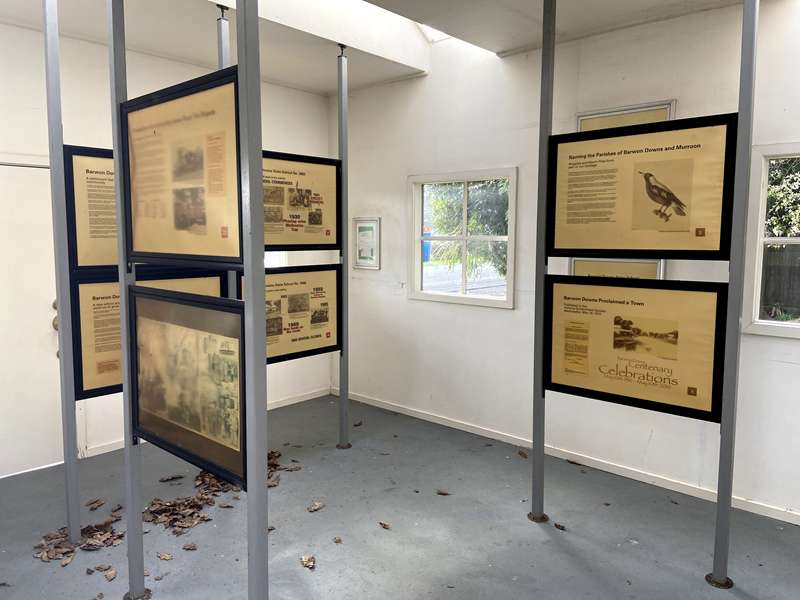
The Barwon Downs History Centre, which was opened in 2010, is located at the Barwon Downs Town Park and is composed of historical information panels.
Some of the panels are:
Banking in Barwon Downs
Australia's smallest bank paraded on world stage
Banking formed an essential part of the timber and farming enterprises, as wages had to be paid, cheques need to be cleared and cashed and savings accounts managed for the farmers, mill workers and their families.
Local Barwon Downs residents can still recall the teller Mr Gullick, arriving in his horse drawn buggy having travelled down from Birregurra to attend to his banking duties and returning to Birregurra before nightfall.
With a record of over 104 years of banking service to the Barwon Downs community to look back on, it's small wonder that the Birregurra Branch and Barwon Downs agency - established by the Colonial Bank of Australasia Ltd in 1876 - was held in high esteem throughout the town and district, until its closure in 1980.
There was plenty of banking competition in the early days with the Commercial Bank using a room attached to the right hand side of Hayden's General Store. The Commercial Bank closed its doors in 1930.
In the same year, Mr William Treble built a hut for the Barwon Downs agency of the National Bank of Australasia Limited – Birregurra Branch, using local timbers sourced from Hayden Bros.
The bank hut was diminutive in size, measuring only 12 feet long by 10 feet wide and was at one time entered in a world magazine competition seeking to find the 'smallest bank in the world'.
The "Wide World" magazine printed a photograph of the Barwon Downs bank building confirming an entry had been received from Australia. The bank failed to win the competition but had the people of Barwon Downs claiming at the time that their bank was certainly the 'smallest bank in Australia'.
The original bank building was located opposite the new 'Barwon Downs History Centre' on the north side of the Birregurra–Forrest Road, where it stood on the right hand side of the original Post Office.
The currency of the day... pounds, shillings and pence
In the early 1900's the preferred currency of choice was coins, representing 90% of the currency used in circulation.
In 1901 following Federation, Australia continued to use the British silver and bronze coins until 1910, when legislation for an Australian currency was enacted allowing the first Commonwealth of Australia silver coins to be minted and released. This was followed by the introduction of bronze pennies and half pennies in 1911.
Bronze and silver coins were released in denominations of: Penny (1d), Half Penny (1/2d), Threepence (3d), Sixpence (6d), One Shilling (1/-), Florin - Two Shillings (2/-).
At the same time, paper notes were unpopular, but gained greater acceptance after World War I when inflation increased, devaluing the Australian currency.
Paper notes were released in denominations of £10, £5, £1, plus a 10/- Shilling note.
Barwon Downs State School No. 2866
A settlement fast becoming a community
In 1885, Mr George Wellings acting on behalf of a group of interested parents, penned a letter to the Education Department requesting the establishment of a school at Barwon Downs.
Accompanying the letter were the names of twelve members of the community, who had banded together to gain a local education for their offspring.
The initial parent group and the number for family children they represented were: George Wellings (7), Roderick McLennan (3), George Scott (1), John Allen (2), Edward Lewis (4), William McNamara (4), Gabriel Taylor (4), John McLennan (3), Joseph Wallace (1), Sam Taylor (2), Thomas W. Fletcher (5), William Wallace Jnr. (2).
Unfortunately on March 3, 1886, the initial application for a Barwon Downs school was declined by the Education Department.
Not to be denied, the parents called a further meeting on August 21, 1886 to renew their effort to gain a school for the children of Barwon Downs. A letter was drafted informing the Education Department that there were now 20 children, five years of age and over and 23 children under five years of age living in the immediate area of the settlement.
The letter included a well-conceived offer to the Education Department by way of a parcel of land on which to locate the school. The parcel of land being part of the northwest corner running five chains south and four chains east of the corner known as Allotment 6, owned by Mr George Wellings.
The letter also stated there were 20 children over five years and 23 children under five living in the district at the time and was signed by the parents' group attending the meeting: Augustine S. Hall, George Wellings, Sam Taylor, Edward Lewis, Thomas Rowland, Joseph Wallace, William Wallace Jnr., John Allen, Robert Lidgerwood, John McLennan, Ann Callahan, Gabriel Taylor, William McNamara, Roderick McLennan.
This time the Education Department agreed to the parents' request and the land was acquired from Mr George Wellings for the principal amount of £5/0/0.
The leasehold transfer was settled on September 8, 1887 and in October of the same year, a portable building with teacher's quarters attached was despatched and the building erected on the site on December 17, 1887.
A certificate of completion was presented by Inspector Pleybill on December 17, 1887 and it was agreed that rent of £4/0/0 per annum be paid by the incumbent teacher for the quarters.
A new school and enrolments continue to grow
Between the years 1888 and 1891, Mr William Cory resided in the teacher's quarters adjoining the school building.
In June of 1891, he agreed to open up the building space to cater for the expanding enrolments, by removing the door and partition dividing the teacher's quarters from the school classroom.
At the same time, Mr George Wellings wrote to the Education Department regarding the erection of a rabbit proof boundary fence, as rabbits were now very prosperous since their release at Barwon Park Winchelsea, by Mr Thomas Austin in 1859. The fence was finally constructed at a cost of £100 per chain in April 1889, with the Education Department agreeing to pay half the cost. A more robust rod fence and gates were completed at a cost of £18/12/0 in early 1891.
In 1903 Mr William Cory, a very popular teacher, was succeeded by Mr Aubrey Liddelow who wasted no time in writing to the Education Department in 1904, requesting a new teacher's residence be provided. Unfortunately Mr Liddelow's request was denied.
It was nearly four decades before the Education Department agreed to the construction of a teacher's residence, which finally was completed in February 1949.
In 1906, Mr Aubrey Liddelow highlighted the overcrowding problem confronting the school and recommended that the remaining room of the teacher's quarters be added to the school to provide additional room for the students.
Isolation and distance had a profound impact on school life for some Barwon Downs children.
In 1907, the Head Teacher Mr Joseph Akeroyd, reported that the following children were travelling to school from a timber mill four miles away and were too tired for school work on their arrival: Edith Smith (age 12 years), Les Smith (9), Keith Campbell (6), Jenny Trew (9), Arch Wight (11), Les Johnson (13), Ann Johnson (11), Helen Johnson (8), Mick Washington (6), Hamilton Amezdroz (9), Ido Amezdroz (9) and May Amezdroz (6).
Naming the Parishes of Barwon Downs and Murroon
Magpies and March Flies form part of our heritage
The local Aboriginal tribe Wada Wurrung (Wathaurong), provided inspiration for the early white explorers of Port Phillip and the immediate areas of Coryo (Corio) and Jillong (Geelong), to use the Aboriginal language to name many of the towns, rivers, lakes and mountains of the area.
The Aboriginal language was recorded by the early European explorers, missionaries and surveyors, all of whom found the language difficult to master and therefore interpreted and recorded the spelling of individual words in many different ways, corrupting the spoken dialect to suit the written English language and ear.
The word 'Barwon' is an English distortion derived from the word 'Barrwong' and came from the Wurrung language used by many of the Aboriginal tribes to describe the 'Magpie', the most common bird seen by the first white people who explored and mapped this part of Australia.
The English expression, 'downs' meaning low hills, near the rise or source of water, in this case the Barwon River, provides the second half of the settlement's name.
The Parish of 'Barwon Downs' was given its official name when the lands were surveyed following the death of Captain Frederick Dewing in 1859.
The 'Paraparap' property was surveyed in two parts. The first being the settlement divided into smaller blocks, the second being larger farming properties, most falling under the 'Parish of Murroon'.
The Barwon Downs parish consists of an area that is bordered by the Parish of Murroon to its north (main Street of Barwon Downs) and the Barwon River to the west. Its southern most boundary point, links with the Kaanglang parish and in the east, the boundary runs along the Otway dividing line, linking with the parish of Lorne. The Barwon Downs parish takes in a large section of the Otway State Forest.
The Murroon parish borders were at the time, determined by the area of land running between Buntingdale Mission to the north and bordered by the Barwon River to the west. Its southern most boundary runs along the main Street of Barwon Downs and in the east, it finishes on the Otway Range line, linking with Bambra and Lorne parishes.
The name 'Murroon' was evidently derived from another Aboriginal word 'Moronoe' meaning 'place of the March flies' – a wild place as aptly named by the Aboriginals frequenting the Buntingdale Mission, and who were said to have provided the name, possibly having it translated by Rev. Francis Tuckfield.
The Birregurra–Forrest railway
Opening the Otway forest to settlement and sawmilling
In the 1860's–70's pressure to open up the timber rich Otway Forest began and many ideas and plans were discussed to construct tramways and rail to provide settlement throughout the region and gain access to the valuable forest within the valleys. After many years of private proposals, it was not until late 1875 that the Government took steps to finally put some of the ideas into reality.
1880's saw the railway movement in full swing and the Cape Otway Railway Act was included in the Railway Construction Act of 1884 and construction of the Cape Otway Forest Railway finally began in 1889.
The railway was officially opened to Deans Marsh on December 19, 1889 and the final extension to Forrest was completed by June 3, 1891.
The line was constructed by Lewis and Hedges at a cost of £147,000 and branched off the main Geelong to Colac line at Birregurra. Stations were strategically located along the line from Birregurra to Forrest, stopping at Whoorel, Deans Marsh, Allen's, Gellibrand, Dewing Creek, Gerangamete, Barwon Downs and Yaugher before terminating at Forrest.
A major feature of the Birregurra to Forrest rail line was the number of wooden trestle bridges and earthen embankments constructed between Barwon, Yaugher and Forrest. The scenery changes dramatically from the openness of the Barwon valley to the short subdivisions of the heavily timbered Otway Range.
Barwon Station was the third busiest station on the line and provided the Barwon Downs timber mills and settlers with access to markets for their timber and farm products.
The trip from start to finish took approximately two hours travelling only 19.75 miles. When the locomotive arrived at Forrest, there were no water or coal facilities, so the train carried sufficient for the return to Birregurra. A 50-foot turntable enabled the locomotive to be turned around for the return trip.
Location
1595 Birregurra-Forrest Road, Barwon Downs 3243 View Map


