Ballarat's Historic Streetscapes Walking Tour


Discover the grand architectural links to Ballarat's dramatic past.
From 1851 the world's adventurers, non-conformists and fortune hunters flocked to Ballarat's goldfields, and along with banks and governments, many sunk their fortunes into the streetscape. Within 10 years, Ballarat boasted the colony’s finest collection of buildings.
Today, the bluestone and handmade brick structures are still as relevant and treasured as ever. They've been reinvented as wine bars and theatres, galleries and bustling cafes, making Ballarat an intriguing mix of old and new.
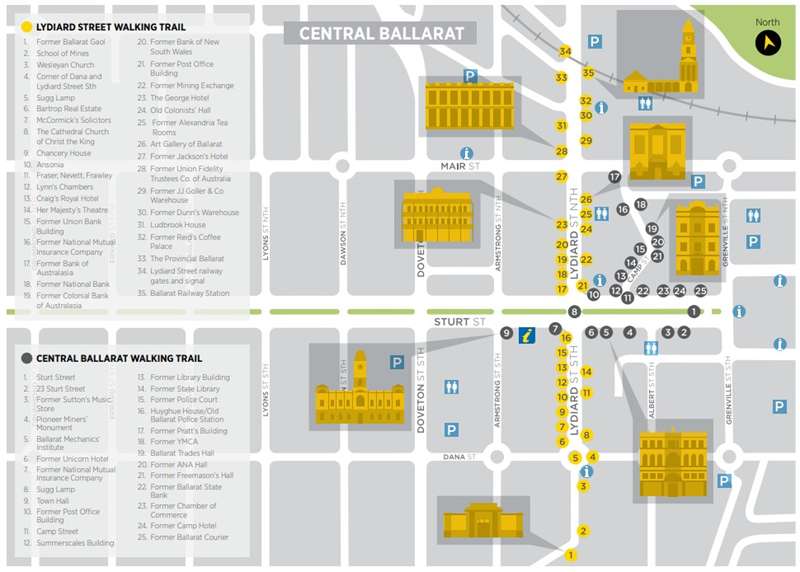
Ballarat's Historic Streetscapes Walking Tour Map
"The fortunes thrown at the Lydiard Street bank buildings tell a story of a city set to impress."
Visit Craig's Royal Hotel, just as generations of socialites, royalty and celebrities have. It was built on the site of Ballarat's first licenced pub, Bath’s Hotel, where the Royal Commission into the Eureka Stockade occurred. Publican Walter Craig famously dreamed of his own demise. In 1870 he dreamt Nimblefoot won the Melbourne Cup, with his jockey sporting a black armband. Craig died before cup day, but the horse did win. The jockey wore the black armband for the publican who had predicted so.
Other great places to stop off for a drink include the George Hotel, Colonists' Club and The Provincial Ballarat. The newly-renovated boutique hotel shows just how loved these historic luxury hotels are.
Her Majesty's Theatre and the Art Gallery of Ballarat are genuine cultural icons. Visit the gallery for first-hand pictorial accounts of the city’s architectural development. It’s well worth stepping inside the stunning Former Mining Exchange too, to imagine the 40 offices in full swing, trading shares in goldmines. The boom style classicism exchange is one of Australia's few surviving, and today plays host to design markets, music festivals, gala dinners and more.
STURT STREET
The six-lane Sturt Street was Ballarat’s original stock route, wide enough for a bullock team to turn, but the best way to view it all is by foot.
Victoria's only surviving Edwardian Flemish Baroque building is located at 23 Sturt Street. Its bright blue tiles are enough to stop traffic. Its original owner, Thomas Belsom, must have been
equally flamboyant.
The Former Sutton's Music Store's German-made leadlight windows celebrated the musical greats of the 1800s. Only one remains, but it’s a beauty. Henry Sutton built a hydraulic lift for his father’s store and is today considered one of the country’s great early inventors.
The Ballaarat Mechanics’ Institute has been a working subscription library since the 1860s. Step inside to see its historic collections, including newspapers from the 1850s. The institute now boasts a packed events and theatre calendar. The rooftop statue of Minerva, Roman goddess of wisdom, arts, trades and intellectual pursuits, is so loved, she’s had local babies named in her honour.
The Former National Mutual Insurance Offices, with its octagonal turret built to house a lift, was the design of John Clarke and son. Clarke was the architect behind Melbourne’s Government House, the Treasury Building and the famous Maryborough Railway Station, proving no expense or effort was spared in the goldfields towns.
The Ballarat Town Hall is forever linked to mad Irishman Henry O’Farrell. After the former local resident took a pot shot at Prince Alfred in Sydney in 1868, the locals made a very public apology. They purchased a set of bells for the building, inscribed them with the assassination attempt and christened them the Alfred Bells. When they rang for the first time in 1871, hundreds gathered before dawn to listen. They still ring today to mark the city’s special occasions.
At the junction of Sturt and Lydiard Streets stands the Former Post Office, Victoria’s second largest after Melbourne’s GPO. Architect William Wardell gave this building the same devotion as his other great works; Melbourne’s Government House, St Patrick’s Cathedral and Collins Street’s ANZ building. The five-level tower includes an arched ground floor entrance for carriages delivering news to the diggings. It now houses Federation University Australia’s Arts Academy, including the Post Office Gallery.
CAMP STREET
Government troopers, ever-keen to maintain a vigilant eye over the diggings, established their basecamp in Camp Street. It was from there that the walk to an infamous bloody battle began on 3 December 1854, when the troopers marched to the Eureka Stockade to assert their authority over the miners fighting for a fair go.
More than 30 people died that day, and Ballarat became the only goldfields town where miners paid the ultimate price for their rights.
The Former Police Court and Old Ballarat Police Station stand proud, now as places of art and music. Prisoners were once chained to a large tree close to the police camp. When it was felled,
parts of it were used for the station. Locals souvenired the rest.
“The melding of architecture makes Camp Street a must-see.”
The Former YMCA, Ballarat Trades Hall, Former ANA Hall and Former Freemason’s Hall point to more peaceful, co-operative times in the city. Local tradesmen proved themselves world-class when the heritage-listed Trades Hall was completed in 1888.
Decades later modernism arrived in Camp Street. In 1939 the 1901 the Former Library Building was given a fresh, minimalist face, and the Former State Government Office – opened in 1941 – was built in stark contrast to its Victorian-influenced neighbours.
This melding of architecture makes Camp Street a must-see. Modern glass facades, rough-faced bluestone walls and weathered cement rendered columns combine in a zigzag street where Instagram-worthy windows present at every angle.
LYDIARD STREET
From the Former Ballarat Gaol to the Ballarat Railway Station, Lydiard Street is the beating heart of a city besotted with grandeur. This impeccably-preserved heritage streetscape is Ballarat’s premier arts and heritage hotspot.
One of the gaol’s most famous inmates was Captain Moonlight; preacher by day, bushranger by night. Sentenced for theft, he scaled the walls and escaped, but was later caught, charged with murder and hanged here in 1880.
The fortunes thrown at the Lydiard Street bank buildings tell a story of a city set to impress. Melbourne architect Leonard Terry designed a series of five banks, neo-renaissance palazzos, like the Former Union Bank, considered his finest work.
The School of Mines is Australia’s third oldest tertiary institution, behind Melbourne and Sydney. Today it’s part of Federation University Australia.
The Cathedral Church of Christ the King is one of Ballarat’s earliest stone buildings, its foundation stone laid the same year as the Eureka Stockade.
Location
Cnr Sturt Street and Lydiard Street North, Ballarat 3350 View Map
Web Links
→ Ballarat's Historic Streetscapes Walking Tour Brochure and Map


