Ballarat - Reveal Ballarat's Past Heritage Walk (Ghost Signs)


Seek out curious stories of Ballarat's past through looking up in this tour. Explore the city's laneways and buildings to find the faded advertising signs and discover the people, places and innovative industries that made Ballarat. You'll cross several streets and intersections on a self-guided walk of about an hour. Please be careful of oncoming traffic at all times and peruse your phone or device with care on Ballarat's streets and footpaths.
Reveal Ballarat's Past Ghost Signs Heritage Walk Map
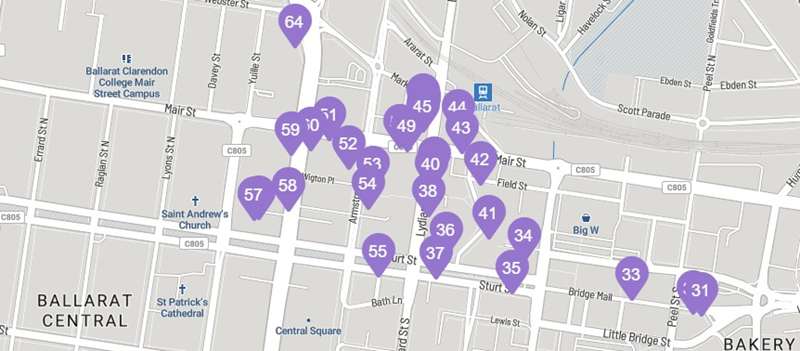
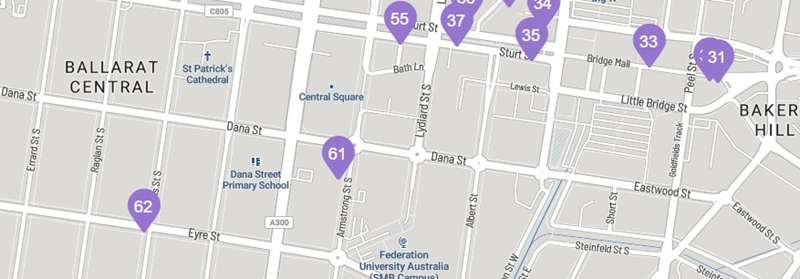
31. Stone's
106 Bridge Mall
The home of elegance and beauty, Stone's clothing store was also home to Jessica Stone, fashion queen of Ballarat.
Jacob Bernstein, a draper, emigrated to Australia in 1854, arriving in Ballarat in 1857. He started his drapery business, with his daughter Hannah and her husband Bernard Stone, later taking over the running of the business and establishing Stone's clothing store.
Stone's was a high end clothing store for women and it was here the young Jessica Stone, Bernard and Hannah's daughter started working with her parents. From the 1930s she was fashion director of the business, running it with her brother Marcus and later also her husband Paul Simon. Over the next 35 years, she built a fashion empire, Stone's was the epitome of style and where you could find the best in boutique bridalwear. Each gown was stamped with the unique Stone's label 'Your Jessica for Luck'.
"If you were looking for fashion for the bridal party, you came to Stone's, and you came to Jessica,"- Val Sarah, Ballarat Courier, 28 November 2014
Jessica's own wedding in 1949 to gold prospector Paul Simon was one the largest Ballarat had seen and there are stories that the police had to be called to manage the crowds.
Jessica was adept at marketing herself, her business and brand. She had a regular Saturday night radio segment on 3BA called 'Jessica's Bridal Bouquet' and a television segment called 'Focus on Fashion' that was filmed in Ballarat in the 1960's and 1970's.
As well as being a successful business woman, Jessica was a great philanthropist. Her 'Mannequin parades' - the fashion parades she held regularly in Ballarat drew huge crowds and made tens of thousands of pounds for charity. A 1956 newspaper article reported that Jessica had raised �22,000 for the Ballarat Base Hospital and been life governor of that institution. Jessica was awarded the British Empire Medal in 1979 for her charitable works.
32. Gears Chemist
100 Bridge Mall
When but a boy I took great delight in gathering and keeping the flowers, seeds and roots of various herbs. One of my favourite herbs was the native yam, the roots of which I then did eat, thinking that by so doing I should soon become a man."- James A. Gear, Ballarat and District 1901.
So began the career of James A. Gear, Herbalist and Botanist "discoverer of the great herbal cure 'WONDERINE'. Look up and you can see the sign for Gear's store.
Born in England in 1867, James was one of the many herbalists, chemists and druggists who treated the sick, injured and ailing in Ballarat in the nineteenth and early twentieth centuries. In 1901 when describing his training he recalled buying herbal remedies from a young age and studying their properties and anatomy "for the purpose of getting a complete description and cause of disease." Ballarat and District 1901.
James Gear's most well known concoction was his "Wonderine" tonic which he created as a treatment for patients. 'Wonderine' was marketed as a cure for a long list of ailments including - headache, indigestion, bad breath, piles rheumatism, sleeplessness, liver and kidney troubles and of course the dubious "female complaints". Ballarat and District 1901.
Being a herbalist could sometimes be a hazard! In 1902 at his premises in Humffray Street South, James Gear was seriously injured while preparing medicines. He was severely burnt, losing his eyebrows, moustache and some of his hair when some methylated spirits suddenly ignited, setting fire to the shop.
33. Walter Davis & Co.
86 Bridge Mall
For more than 90 years Walter Davis stood for elegance and high quality fashion. The iconic Ballarat store serviced the ladies of Ballarat in all their fashion needs from day wear to wedding and debutante dresses. The sign you see at the top of 86 Bridge street, has a hidden story behind it of an immigrant searching for a better life in Australia and a tenacious woman who established a successful business for generations of her family.
Tannous Dabes (later known as Davis) emigrated to Ballarat from his home village Bkfaya, in Mt Lebanon in 1891, joining a small Lebanese community in the city. Separated from his wife Elizabeth and three young children, Joseph, Walter and Victoria for six long years, Tannous spent his time setting up a hawking business travelling around Ballarat and surrounding districts selling goods.
By 1897, Tannous had saved enough money for his family to emigrate to Australia and in 1899 their daughter Minnie was born in Ballarat. That same year brought much hardship for the family when Elizabeth was left with an infant and three young children to support when Tannous died suddenly from pneumonia.
Elizabeth however was not going to give up. With her husband gone, and a young family to feed she set about ensuring their survival. Taking her young boys Joseph (12 years) and Walter (10 years) out of school, she set about travelling the Ballarat districts in a horse drawn cart selling her wares.
"Elizabeth's determination and resourcefulness and the assistance of her two sons enabled the family to pull itself out of poverty. Over the next few years the hawking business prospered and the range of their activities increased. By 1906-1908 they were able to hire a railway carriage twice a year and stop at country towns sometimes for a week to sell their goods before moving on to the next town. An elderly lady in Mildura recalled the great excitement of the hawkers' visits and the lovely goods they would sell."- Dr Trevor Batrouney, Australian Lebanese Historical Society of Victoria
By 1908, Elizabeth with her son Joseph were able to purchase and manage a white goods business in Prahran.Walter continued the hawking side of the family business, and in 1920 purchased and opened Walter Davis at 86 Bridge Street - the shop you see before you today. Situated in the shopping centre of Ballarat, the store sold ladies, men's and children's wear, manchester and household furnishings before specialising in ladies and girls fashion by 1930.
Walter and his brother Joseph became well known in the Ballarat commercial community and early adopters of new business innovations. Walter was the first to introduce time payments (layby or installment purchases) to Ballarat, becoming known in Ballarat as "TP Walter".
When Elizabeth died in 1935 and Walter Davis continued to thrive into the 1940's and all members of the family - brothers, sisters, cousins would work in the store over the next 60 years until the business was sold in 2004.
34. Richards & Co. Photographers
10 Sturt Street
The name of Richards & Co Photographers can still be seen etched into the top of this building, evoking extravagant window displays and studio equipment and backdrops, the most modern of their day. It must have been a splendid thing to walk past Richards and Co's artful 'exhibitions,' made specially for the seasons.
"Beautiful ! Lovely ! Charming ! These were the expressions heard on all sides from those admiring the new Christmas display by the well known Ballarat photographers, Richards and Co...They are in reality works of art in every sense of the term... The backgrounds are new, the mounts are new, and here are shown all the latest styles and processes in modern photography."- Camperdown Chronicle, 1906
Richards and Co was established in 1872 by George Richards. He traded for about 10 years before selling to John Dearden, who was known for his skill and well equipped shop, having travelled to Europe to procure and learn about the latest photographic technology for his Ballarat store.
"The beautiful display in 23 Sturt St is well worth any similar exhibition in Melbourne and Sydney...The front is occupied by a window tastefully arranged with photographs of every description, some of them being of the principal people of Ballarat…"-WB Kimberley (Ballarat & Vicinity, 1895)
John sold Richards & Co to Phil Thornton, hence the current name of Thornton and Richards (still operating from further up Sturt St). Phil was a florist and traded as Eden Photographs. Thornton Richards captured many local events such as St Patrick's first roll call in 1893 and the fire station's first milestone, as well as many a wedding and social event.
One of Phil's employees was Merv Lewis who had worked as a radio operator during World War II. Merv went on to marry Moira, the receptionist at the studio, and purchased the business from Phil Thornton in 1953.
The tradition of embracing new technology has been a constant for the company, with a developing and printing complex being installed in 1965 that would serve the whole of Western Victoria, a new daylight processing lab in the 1970s, one hour photo processing in the 1990s, then the introduction of digital cameras, through to the self serve printing kiosks of today.
From 'Thornton Richards Camera House: Celebrating 140 Years' by Sue Lewis, 2012
35. Carlton Draught/Union Hotel
11 Sturt Street
"People travelling with their families and solicitous to secure comfortable quarters upon reaching the city, are more than gratified when quiet accommodations, and that freedom not to be found at the larger and more public hotels, are placed at their disposal. Those visiting Ballarat and desirous of quarters of this kind are recommended to register at the Union Hotel, of which Mr. Con Burrow is proprietor, and in which he is assisted by his estimable wife, who makes it a rule to take special care of lady and children guests"- Ballarat and Vicinity, 1894
Perched high up on the Eastern side of the three storey building in front of you is a Carlton Draught sign. This is the former Union Hotel, which operated for almost 150 years. Built by J.Retallack in 1863 it is today one the only remaining examples of late Victorian gold rush architecture.
One of the characters from the hotel's history is Con Burrow, who from 1892-1903 owned and managed the twenty roomed hotel with his wife. Born in 1857 in England, Con Burrow was a veteran of the British Army. Enlisting at only 11 years of age as a drummer and trumpeter in the grenadier Guards, he fought in numerous campaigns in Egypt and was awarded various military medals for service and valour. He often capitalised on his military service in the advertisements he placed for the Union Hotel in local newspapers.
Under his management, he sought to have the hotel known for the quality of its refreshments, "serving only the best of liquors and fragrant havanas, to secure and maintain the patronage and goodwill of all" - Ballarat and vicinity 1894
His 21 years experience as a military man must have held him in good stead to deal with the sometimes rowdy clientele of the local Ballarat watering holes, when he was described as holding, "an enviable reputation as a crack shot, having own several valuable medals, and there are few, if any, in Ballarat who care to try conclusions with him." - Ballarat and Vicinity, 1894
Con Burrow sold the Union Hotel in 1903, moving to Barwon Heads. His departure from Ballarat was a greatly lamented in the local Ballarat newspaper The Star where he was remembered as a great sportsman and genial businessman who participated in so much of Ballarat's civic life in parades and public events. Mayor Shoppee wrote to Mr Con Burrows on behalf the citizens of Ballarat saying:
"We gratefully acknowledge that the influence exercised by your earnestness, enthusiasm, and patriotism, has been of great value especially to the young men of this city.
'An' aye the gold of wattle grows
With the shamrock, thistle and the rose'
In bidding you farewell we wish to assure you of the great respect and admiration with which we regard you and Mrs Burrows, and to express the hope that you may be long spared to exercise your great social gifts and fervently patriotic spirit." Ballarat Star, saturday 11 July 1903.
36. Ipana Toothpaste
104 Sturt Street
Look up and you can see a curious little sign for Ipana toothpaste which has somehow survived unscathed over time.
Ipana was a popular toothpaste produced by the American Bristol-Myers Company from 1901 until the 1970s when its sales declined because of competition from other brands like Colgate.
Bristol-Myers developed some innovative marketing ideas for the toothpaste over the decades, capitalising early on opportunities that new technologies in mass media presented. They were one of the first companies to sponsor radio broadcasts - with the 1923 radio program The Ipana Troubadors.
With the rise of television in the 1950's, Ipana created Bucky Beaver as the marketing icon for the brand with his slogan "Brusha..Brusha...Brusha". The Bucky Beaver ads were famously referenced in the 1978 movie Grease when the character Jan sang the brand's jingle.
37. Beacham's Unicorn Hotel & Billiards
131 Sturt Street
The current Unicorn Ballarat, formerly the Unicorn mine claim and shaft, has traded under different names including Healy's, Honan's, and Beacham's Unicorn Hotel.
A very faint sign can still be seen on its side advertising Dining and Billiard Rooms. You can see it in former days in one of the photographs below. At the top of the front verandah you might also see a trace of signage recalling a past proprietress, a Mrs E Beacham - one of Ballarat's many female publicans - who boasted of comfort and relaxation at "Ballarat's oldest Established Residential Hotel."
Billiards were a popular pastime in Ballarat, with rooms here as well as at the Mechanics' Institute just down the way (pictured below). During the world-wide resurgence of billiards in the late 1870s, the Mechanics Institute purchased four full size snooker tables for a dedicated room on the top floor. Such tables can still be seen and used at the Old Colonists Club on Lydiard St.
The earliest reference to the Unicorn Hotel appears in The Miner 1856, when Thomas Vaughan was the publican. The hotel was the third to be erected in West Ballarat, after Baths (now Craigs Royal Hotel) and The George, and became the centre of exciting incidents connected with the original Mining Exchange next door. The building used to feature a parapet which extended out over the balcony carrying a unicorn.
38. Mobil Oil
20-22 Lydiard St
Opened in 1889 for the selling and trading of gold shares, the Ballarat Mining Exchange is one the few remaining examples of nineteenth century exchanges in Australia. Walk around and above the booths you can still see the names of the some of gold and share brokers who traded here.
By 1923, share trading on the site had ceased and Barlow Motors was operating its garage and showroom from the building. Look towards the far end of the Mining Exchange and you'll make out the the large Mobil Oil sign that Barlow Motors painted. The motor vehicle was on the rise and Barlow's provided customers with only the best and latest models. It marketed itself as "the most up to date garage in the Commonwealth" and was open 24 hours a day to tend to any of your motoring needs.
By 1954 the Mining exchange was a bus depot and later in the century became disused. In 2004 it underwent a major heritage renovation, restoring it to some of its former glory.
39. Ballarat Fine Art Gallery
38-48 Lydiard St
The Art Gallery of Ballarat was originally known as the Ballarat Fine Art Gallery and was established in 1884 by a group of interested local citizens who felt that an art gallery would improve the morals and culture of a rough, working-class, mining city. The Gallery Association occupied a large room in Her Majesty's Theatre, until they could secure their own premises. The Victorian Government gave the Association this site in Lydiard Street North, which had been part of the old Police Camp – a large police barracks used to stand on the site and the new Gallery building was opened by local MP Alfred Deakin in 1890. In 1988, the Gallery expanded into Bones' Buildings, a group of three shops which were part of a bequest to the Ballarat City Council by local businessman William Robert Bones who left his property to the Council in 1930, on the condition that it be used for the improvement of the city. The painted sign facing Police Lane was likely put up in the 1920s or 30s. - Peter Freund
40. Clyde Batteries
Police Lane
One of the more beautiful signs on the trail is the Clyde Batteries sign here on Police Lane. We know very little about this sign.
41. Paterson, Reid & Bruce LTD
10 Camp St
A simple advertising sign hides the somewhat complicated story of this Victorian import and soft goods company and two industrious men, John Munro Bruce and Robert Reid.
Established in Geelong in 1850 by J.C. Young, a Ballarat branch managed by John Paterson was opened in 1852. In the 1850s, operations were moved to Melbourne, where Paterson was admitted as partner in the company. In 1860 it changed its name to Paterson, Palmer and Company, changing again in 1878, to become Paterson, Laing and Bruce, with John Munro Bruce, as its co founder.
Born in Ireland in 1840, John Munro Bruce migrated to Australia in 1858, landing at Melbourne at 18 years of age. In 1860 he joined Laing and Webster, and by 1868 had become a partner in the business. As a driving force behind Paterson Laing and Bruce, he oversaw the development of the company into one of the major import and soft good companies in Victoria. By 1883 the Paterson, Laing and Bruce Flinders Lane warehouse was the largest in Victoria.
Outside of his success as a businessman, Bruce dedicated much of his time to community affairs in a range of roles. These included acting as Chamber of Commerce delegate at the intercolonial conference in 1883, commissioner of the Centennial exhibition, serving as president of the Young Men's Christian Association (YMCA) and Melbourne Hospital and holding the Captain's rank in the Prince of Wales Light Horse. He had an interest in politics, which he fulfilled in his role as chairman of the coalition committee, securing support for the Gillies-Deakin administration in 1886 general election. His son would later become Prime Minister of Australia from 1923-1929, and later Viscount Bruce of Melbourne, the only Australian Prime Minister to be awarded a peerage.
Robert Reid was another enterprising immigrant who built a successful company. A competitor of John Munro Bruce for many years, the stories of these two men would in later years intersect. Born in Scotland in 1842, he emigrated to Australia with parents, arriving in Melbourne in 1855. Within weeks of landing, Robert's father passed away and Robert found himself responsible for supporting his mother and five sisters at the tender age of 12.
His early career involved working as a shop clerk on Collins street, and for a short period of time in Ballarat. In 1874, Reid struck out on his own, establishing a wholesale drapery importer in Flinders Lane (known as 'The Lane') with Edward Warne and John Adair. By 1882 he employed 250 staff in the manufacturing warehouse in Collingwood, and in 1887 changed its name to Robert Reid and Co. Reid's motto in life was 'Do your best every day and never miss a chance' and it seems he lived up to this when it came to his business ambitions. By 1890 Reid's company was the largest importing business in Australia, with branches in London and Glasglow.
Like his competitor John Munro Bruce, Robert Reid was an active participant in the commercial and community life of Victoria. He had a long affiliation with the Baptist community in Victoria, serving as chairman of the Baptist Union of Victoria. Amongst many other roles, he was President of the first Congress of the Chambers of Commerce in Australasia during the Victorian centennial exhibition, President of the Melbourne Chamber of Commerce for periods between 1888 and 1902. He received the cross of the Legion d'honneur for his role as commissioner at the Paris exhibition of 1889. He entered politics in 1892, being elected to the Legislative Council for the Melbourne Province, holding the health and defence portfolios from 1893 to 1894 and in 1902 oversaw public instruction (Education) and health in the Victorian government.
In 1966 Robert Reid & Co. amalgamated with its long-time competitor Paterson, Laing & Bruce. The two successful companies that these two industrious men had built became the Paterson, Reid & Bruce you can still see on the sign above you today.
42. YMCA
40 Camp St
The Young Men's Christian Association (YMCA) was founded in England in 1844. Centred around Christian teaching and the philosophy of improving the welfare of young men, the YMCA sought to provide recreation spaces where young men could gather to have fun away from the temptations of the world like alcohol and gambling.
By 1853 YMCA's had popped around the world including Australia. The associations during the later half of the nineteenth century started to develop programs centred around exercise and health as a means of promoting healthy lifestyles for young men. Athletics and sports were a major focus.
In 1907 the Ballarat YMCA committee was working hard to raise funds for the purchase of land in Ballarat in which to erect a hall to gather and deliver their programs. Unexpectedly they received a gift of land on Camp Street from a Mr J.W. Wilson and subsequently erected the YMCA building that stands to this day. The building was opened by former Prime Minister Alfred Deakin at a public event on 25 January 1909.
43. Pratts/Kelsalls/Smail Bros
Cnr Mair and Camp street
Dotted over the walls of the imposing bluestone structure known to locals as Pratt's warehouse are signs that provide clues to the history of this rare example of Victorian industrial heritage.
Designed by prominent local architect JA Doane in 1869, the building was originally known as McDowall and Gray's warehouse. Built soon after the opening of the railway from Melbourne to Ballarat its location provided convenient access for the delivery and storage of a range of goods needed by the booming Goldfields community.
Over many years the building had a range of merchant tenants. On the Eastern side of the building you can look up and see the sign of Kelsalls wool and skin merchants.
Also on this side of the building you can see the sign for David Pratt and Sons General and Produce Merchants. David Pratt had worked as manager of Jermyn's Cheap Stores just down the road on Mair street. When Jermyn became insolvent in the early twentieth century, David Pratt took the opportunity to buy his Mair street store. Subsequently over the years he purchased the Raefisch building next door.
David Pratt's young sons, James Robert Pratt and John Gradon Pratt left school and commenced working in their father's business. Pratt's continued the same trade as Jermyn's, selling grains and feeds and grocery and foodstuffs.
In 1943, David Pratt purchased the bluestone warehouse on the cnr of Mair and Camp streets. It provided a large warehouse for the grain and large crates of groceries and food stuffs.
44. S.Flohm Sign Writer
20 Mair St
The Flohm family, prominent members of Ballarat's Jewish community, once ran their clothing shop out of the Bones Building. One of the sons, Sol Flohm, ran a signwriting business and the promotion for his business can still be seen on the back of the building in front of you. Sol was the scene painter for Her Majesty's Theatre during the 1930s, and described himself as a Novelty Sign Writer, Advertising Contractor, Decorative Artist, Scene and Banner Painter. In 1915 he was involved with creating a 'handsome' Honour Board for the Sebastopol Council, said to be greatly admired by the ratepayers. It seems he was multi-skilled like many of the people featured on this trail and was involved in various arts and societies. He was awarded the First Prize medal at the Bendigo Exhibition, and as a member of the Ballarat Jewish Literary and Debating Society (initiated in 1908) performed as part of a musical and elocutionary program in the schoolroom adjacent to the Ballarat Synagogue.
45. The Palace Hotel
101 Lydiard St Nth
If you crouch down at the entrance to this barristers and solicitors office you will discover the original purpose of this imposing and commanding building on the corner of Mair and Lydiard Streets.
The Palace Hotel was built in 1887 by Hugh Raverty for 15,000 pounds. The huge 40 roomed hotel was managed by Helen Raverty after her husband Hugh's death. Helen was frequently up on charges at the local court for having her pub open and serving drinks outside of regulated hours.
In 1918 she surrendered the licence when the hotel was sold to the Ballarat Trustees and Executors Agency for 6,000 pounds. Ballarat Trustees and Executors Agency took up premises in part of the building leasing offices to tenants like F.S. Howie's Dental surgery.
46. F.S Howie Dentist
103 Lydiard St Nth
Poke your head into the portico of the northern entrance to the old Palace Hotel and State Trustees Building and there you'll find the 92 year old advertisement for F.S. Howie Surgeon Dentist. But this isn't just a sign that highlights the story of a business, it's also the story of a man and a woman of strong conviction who throughout their lives never wavered in their beliefs.
Francis Samuel Howie was a well known dentist in Ballarat for more than fifty years, having been registered to practice in 1904. Francis married Kate Maud Williamson in 1898 at the Society of Friends (Quaker) meeting house in Ballarat.
Quaker women in Victoria were extremely active in the Women's Suffrage Movement - the campaign for women to be given the right to vote. In 1891 Kate, her sister and mother were three of the 30,000 Victorian women who signed the "Monster petition" - a petition submitted to the Victorian Government requesting women's equality and the right to vote.
An active member of the Ballarat quaker community, Francis was strongly against the drinking of alcohol and was committee member on a number of groups who sought to limit or remove alcohol completely from sale, these included the Temperance Society and the Total Abstinence Society.
A prolific correspondent to the newspapers, his letters regarding military service and the First World War were probably his most passionate and eloquent. As a quaker he believed in pacifism and spoke out against the war and proposals for conscription. The family left Australia for San Francisco California in 1917. At a gathering of the California Meeting of Friends Church in June 1917, Francis explained that he and his family had relocated to California "because of the pressure of the military spirit in their former home".
By 1924 the Howie family returned to Australia and in July of that year, Francis Samuel or F.S. Howie opened his dentist surgery in the building you see before you. Francis continued his community work outside of his business, becoming President of the Ballarat Helping Hand Committee, a group established to assist post World War 2 European migrants who were arriving in the city to rebuild their lives. The committee purchased new homes for the migrants and the provided support services like English lessons.
Francis Howie died in 1968, at the grand age of 93, his wife Kate having died 10 years earlier. They are buried together in the Ballarat New Cemetery.
47. Printers & Bookbinders
105 Lydiard St Nth
In this sign the words Printing and Bookbinding can be seen. While we don't know which business operated from this building, on the opposite corner of Mair and Lydiard Streets the prolific F.W Niven & Co. Printers & Lithographers were once sited. Printers like Niven played an important role in creating the visual documentation of Ballarat life.
F. W. Niven & Co. became a large provincial printing business in Ballarat, at its peak employing seventy workers and having some �7000 worth of machinery. The firm began a publishing campaign in the 1870s that brought it international recognition for elegantly produced books such as W.B Withers' History of Ballarat (1887) and The Cyclopedia of Victoria (1903-05).
Innovators in printing methods, lithography was a significant part of the firm's success and in 1873 Niven imported one of the earliest known commercial steam lithographic presses in Australia. He took an interest in nature printing, which led to the development of the 'Crisp Photo' process, with Henry Crisp's assistance, for colour lithography- an advertisement for which you can see below.
Another local company Berry, Anderson & Co. are still operating today from their Dana St premises, supplying quality printing, stationery and packaging supplies to Ballarat and surrounding districts since the days of the Ballarat Goldfields. Look out for more on McAlpin's at the next stop.
48. McAlpin's
105 Lydiard St Nth
"McAlpin's Malto -Pepsin Self Raising Flour, there's no other. Prove it against any other flour you like" - Sunshine Advocate Saturday 13 October 1928.
McAlpin's was a major Victorian flour company in the nineteenth and early twentieth centuries. Owned and operated by J. McAlpin and Sons, the company sold its flour products across Australia and overseas.
McAlpin's had a canny marketing campaign which was focussed heavily on the housewives of Australia. One innovation was the publishing of a free cookbook which had recipes in it that used McAlpin's products. These free cookbooks were published successively from the 1930s through to the 1960s in Australia.
Food manufacturing was a huge part of Ballarat's history. In the nineteenth and early twentieth centuries Ballarat was home to manufacture of almost every kind of food product you could think of from, George Farmer's Hams and Bacons, Andrew Austin and Co's Jams, J.W. Malin and Sons Tomato Sauce and the well known John Long's Sunshine Biscuits.
49. Cincotta Fruit & Veg Merchants
201-209 Mair St
A vibrant sign advertising Fruit and Vegetables and 'flowers our speciality' can be seen down this lane beside Jacksons Hotel. If you look very closely you can see traces of Cincotta signage on the front of this Mair St building as well.
50. Isaac Abraham
213 Mair St
Gold buying, pawnbroker, jewellery, sporting goods, footwear, clothing and the famous Cumberland bicycle! Isaac Abraham's store had it all!
Look up and not only can you see the name of the founder of the business above, but also the traditional symbols of the pawnbroker - the three balls or spheres. According to legend, the balls date back to the Medici family of Florence who slayed a giant using three bags of rocks. The three-ball symbol became the family crest and since the Medicis were so successful in the financial, banking, and moneylending industries, other money lenders and eventually pawnbrokers also adopted the symbol.
Born in Ballarat in 1864, Isaac built the store you see before you in 1922. His son Elias and grandson John followed him into the family business until 1995 when it finally closed its doors.
Having followed his father into the gold buying, jewellery and pawnbroking business, from the late nineteenth century Isaac expanded, first into sporting goods and later between the wars into music and musical instruments - Abrahams was the biggest record store in Ballarat at that time.
Here you could buy the famous Cumberland bicycle, Abraham's own brand of bike. Upstairs you could visit the Cumberland mechanic for all your bicycle repair needs. It really was the store to meet all your needs, the place to find that perfect gift.
"When one cannot make up his mind exactly what he wants to give for a Christmas present a visit to Isaac Abraham's new warehouse in Mair Street will likely be likely to suggest the very thing that would be liked best. The variety of suitable presentation goods on view is almost endless, and a few of the most striking examples are the wheel toys for children, comprising waggons and self-propelled motor cars. The l923 models of their celebrated Cumberland bicycles are shown in various styles. The firm state that this text is the best model yet produced."- The Ballarat Star, 21 December 1922
The Jewish community in Ballarat was thriving in the nineteenth and early twentieth centuries and the Abraham family were active members. Outside of their work, both Isaac, his father Sydney, son Elias and grandson John served as committee members of Ballarat's Hebrew Congregation.
51. Sun Plating Works
321 Mair St
What were the Sun Plating Works? Was it some kind of electro plating company and who established it?
With thanks to Rod Irvine for the following information: "The business was owned by my grandfather Charles ("Wanga") Williams, who according to my mother received his nickname from his playing days at the Ballarat Football club. It was an electro plating business that was originally located at 305 Mair street (which is now a part of Campana's wine merchants). The business was established at 305 in 1933, and moved to 321 Mair street in 1946. Unfortunately my grandfather died at a relatively young age of 56 as a result of a cerebral aneurysm, possibly related to his trade."
52. Hames & Woodward
27 Armstrong St Nth
Look up and on the top of this building is the sign for Hames and Woodward. We don't know a lot about this sign and business except that it was a piano and music warehouse where you could get the latest piano or gramophone! The building was also home to Loveland Cycles for a time.
From The Courier March 1st 1978
THE GOOD OLD DAYS IN ARMSTRONG ST. NORTH
Mr George Richmond began work in Armstrong street north as a lad in knickerbockers in 1926.
He started with Hames and Woodward, a piano, music and record shop, which he took over when both Hames and Woodward died during the war.
Mr Richmond was guest speaker at an informal dinner of the Armstrong St North Traders Association held at the Victoria Hotel on Monday night.
At the meeting he was made a life member of the association, with which he had been involved since its inception in 1930.
“I can remember when a man on a bicycle with a little ladder on his backrode up the street with a long stick and turned on the gas lights under the verandahs,” he said.
“It was around that time when there used to be a little man with a broom walking up and down the street, sweeping away what was left behind by horses.
“There also used to be a bellringer who would walk up and down Armstrong street announcing a sale in a shop. He used to have a tall black hat, a large black frock coat and had a large mustache.”
“Up to 1936, there used to be regular visits by street musicians, who were usually good for a few laughs.”
“The last musicians to come through were an Italian trio, who were very good.”
Mr Richmond said the depression was a sad time for Armstrong street. “A lot of people had to put their properties up for sale, because not many people could afford to buy things like records then,” he said. Mr Richmond said Fridays were very busy then as it was market day for hundreds of farmers in the area.
“The hotels put on extra groomsmen for the stables, and standing in the store I could smell the beer and tobacco drifting down from the hotels.”
53. Roy Hammond Signs
24 Armstrong St Nth (lane)
Possibly the most artistically beautiful of all the signs on this trail is this one for Roy Hammond Signs tucked down this laneway off Armstrong Street North.
54. Jim Welsh Dance Studio
12 Armstrong St Nth
Ballarat dance royalty Marge and Jim Welsh moved to town in 1960, opening their own studio (Jim Welsh Dance Studio) that was soon to become one of Ballarat's favourite places to dance. Jim and Marge taught generations of people in Ballarat to dance for their debutante balls to their wedding waltz. Many a Ballarat couple met through their love of dance.
Marge and Jim even had a weekly segment called Let's Dance on local Ballarat television BTV6 with compere Max Bartlett. This exposure made them a hit when visiting country towns to film segments.
The Ballarat team for dance competitions were the Ballarat Poodles named after Marge's beloved pet dogs, and their outfits saw poodles emblazoned on their dresses and jacket pockets.
"Marge was readily identifiable in Ballarat because of her two poodles; the white dog was regularly blue one day, or orange the next, to match her hair colour."
-Peter Butters, Recollections
Tributes poured in to honour Marge's memory and the joy of dance that she and Jim shared with the city when she passed away in 2015.
55. Royal Bank
Cnr Town Hall Lane & Sturt St
The Ballarat Town Hall is not all that it seems. The ghostly, almost faded sign you can see on the eastern wall of the building in Town Hall Lane is one of only a few remaining clues to the curious uses this building has had over time.
In 1861, new municipal offices and a police court building were opened to replace the earlier wooden town hall which had burnt down in 1859. In 1868 a competition was announced for another town hall design that would incorporate the 1861 buildings into a new design increasing the size of the building and including shops which could be commercially leased. In 1872 the completed building was opened.
The Eastern corner of the building where you are now standing is where the original 1861 building was incorporated into the 1872 building design. Here the city police court operated for many years until the space was let to the Royal Bank in 1907. The Star newspaper reported in 1907:
"Some extensive alterations are about to be made to the old City Police Court, in the municipal buildings, Sturt street. The place is to be turned into a banking chamber, and the Royal Bank, which is at present conducting its business in the rate collector's office, at the City Hall, will take possession of it permanently when the alterations have been completed."-The Ballarat Star, Friday 25 January 1907.
When the Royal Bank ceased operating within the Town Hall, the offices were then let to a doctor. Inside you can still find the old bank vaults and the cells beneath the building where prisoners were kept before attending the city court. The Armstrong street corner was also let to the Commercial Bank of Australia. They occupied the space for an astonishing 97 years, vacating the building in 1965.
56. Cecile Black
422 Sturt Street
As one of the few hand painted window signs on our trail, we would love to know more about who or what Cecile Black was. Was this a clothing store? Was Cecile Black a person or the name of a range of products?
57. Ballarat Disposals
424 Sturt Street
Looking for a tent, camouflage clothing or a hardy water bottle or can? 'Disposal' or 'surplus' stores selling excess military or army supplies starting cropping up in Australia after the First and Second World Wars. When peace was declared, the military found themselves with a problem - large supplies of goods like tents, helmets, uniforms and kits which they no longer needed. Disposal stores were set up to sell these surplus goods to the general public.
In the 1960s Ballarat Disposals is advertised as 'Ballarat's Camping Specialists' and had stores in this building as well as Bridge and Mair Sts.
Look up and you can see the huge sign for Ballarat Disposals, a business we don't know a whole lot about.
58. Pencil Mark Lane
Cnr Pencil Mark Lane & Doveton St Nth
These intriguing signs are a bit of a mystery. One business that operated from this site was Young Brothers, a tailoring business. Perhaps the references to suits at the top of the sign refer to them?
59. Dixon Bros Produce Merchant
25 Doveton St Nth (lane)
Imagine the street before you choked with men and women, the cries of auctioneers and the smells and sounds of horses. The sign you see before you is one of the few remaining clues to the history of this part of Doveton street.
Dixon Brothers were grain and produce merchants who provided a range of services and products to the people of Ballarat in the late and early twentieth century. Born in 1860, Joseph Dixon attended school in Ballarat until the age of 16 when he started working as a grocer. In 1879 he established Dixon Brothers, operating it with his brother John. They had a chaff cutting operation at the corner of Brougham and Doveton Streets and the commercial sales part of the business operated out of the building you see before you. Here wholesale grain and produce were sold, including farm machinery, tents, tarpaulins, water bags and cow and horse rugs.
This portion of Doveton street was a hub for agricultural and horse sales in the nineteenth century with produce merchants, horse bazaars and farriers all plying their trades between Sturt and Mair Street. In the image below you can see one of the popular horse sales that were held on the street, just near the Dixon Brothers store.
60. Geo A Lemke Quality Canvas
38 Doveton St Nth (Lane)
Look up and you can still see the impressive sign advertising George A Lemke's Quality Canvas. Born in 1891 in North Melbourne, George Adolph Lemke moved to Ballarat, opening his canvas and tarpaulin manufacturing business in 1911.
World War 1 interrupted George's business activities. In 1917 he enlisted in the Australian Imperial Force (AIF) serving overseas as an air mechanic in the Australian Flying Corps. George's service is recognised on a plaque on Ballarat's Avenue of Honour, along with 3911 other men and women from Ballarat and district who served in the Great War.
After the war he returned to Ballarat and in 1920 his business was located at this current site, 18 Doveton Street South. This portion of Doveton street was a hub for agricultural and horse goods. In the street could be found farriers, saddlers and produce merchants. Horse sales held on the street outside Lemke's business drew large crowds of people.
George A Lemke produced and sold a range of canvas products, including tarpaulins, verandah blinds and window blinds, water bags, deck chairs, cow and horse rugs, hammocks and tents.
Outside of his business activities, George had a love of singing and was a talented baritone vocalist, competing in and winning many competitions. When he travelled to Tasmania in January 1924 with a Ballarat Choir, his performance in Hobart was described in the local newspapers:
'The solo work generally was good, and that of Mr George Lemke was a great treat and was a quite a feature of the entertainment. He possesses a fine voice and his interpretations were a revelation.' - Launceston Examiner, 23 January 1924
61. L.E Cutter Coach Builder
110-112 Armstrong St Sth
1853, and Ballarat was in the grip of gold fever. Every day people were arriving to try their luck on the goldfields or to set up businesses catering to the needs of the booming population. Coaches, wagons and other forms of horse transport were in high demand.
Stretching along the south side of the building in front of you is the name of one of Ballarat's earliest and most successful coach building businesses - L.E. Cutter. Here Laurence E. Cutter and later his sons, built their award winning carriages and coaches that were be sold across Australia and the world.
Established in 1853, as Cutter and Lever Coach builders, the business later known as L.E. Cutter or Cutter Brothers was one of the premier coach builders in Australia. Here all manner of coach, gig, sulky or trap was produced to the highest quality using only the best wood from Australia, America and England. L.E Cutter Coach and Carriage Builders frequently won awards for their innovative and beautiful designs. In 1866 one of their coaches was exhibited at the Intercolonial Exhibition Melbourne and chosen to represent the manufacturing feats of the Colony of Victoria at the Paris Exhibition.
As technology changed so too did Cutter Brothers. By 1916 they had expanded into the manufacture of motor vehicles.
'MESSRS L. E. CUTTER AND CO.. A visit to Messrs L. E. Cutter and Co.'s carriage and motor factory, at 114 Armstrong street, will prove a revelation to most people on account of its magnitude and the wide range of work the proprietors undertake. Undoubtedly the most interesting department is that devoted to the manufacture of motor cars. At present there are several of these in course of construction, and those who are privileged only to see the finished article flashing past in the street have much to occupy their attention and to excite their interest in the observation of the amount of detail and mechanism necessary for the production of a first grade car. The coachbuilding branch, at which also a large staff is employed, may likewise be inspected, together with a large collection of completed cars and vehicles. Several of the latter were successfully exhibited at the late agricultural show.'- The Courier, Wednesday 11 October 1916
In 1916, Cutter Brothers built a new ambulance for the 6th Field Company, Australian Medical Corps serving overseas during WW1. Named 'Ballarat' the ambulance's construction was supported by funds raised from a performance by Dame Nellie Melba held at the Coliseum theatre in 1915.
62. Ballarat Bertie
Cnr Eyre & Lyons St
This is the story of a little man who captured a city's imagination, it's the story of Ballarat's own Bertie.
In 1926 the Ballarat Brewing Company launched its first major advertising campaign, using the character of 'Ballarat Bertie'. The brewing of beer had been an important part of Ballarat's manufacturing history since the arrival of miners to the Ballarat Goldfields. Ballarat Brewing company was established in 1910, after the amalgamation of three breweries, William Tulloch and Alexander McLaren's Royal Standard Brewery, James Coghlans' Phoenix Brewery and Henry Leggo's Barley Sheaf Brewery all established in 1857 .
Given the brief of creating a character like that of 'Johnny Walker', O'Brien's Advertising (later Mooney Webb) created Ballarat Bertie, a cellarman at the brewery to market the Ballarat Brewing Company's stouts, ales and lagers. On the wall in front of you, you can see an example of an advertisement for Ballarat Bitter using the Ballarat Bertie image. Signs like this were once found in many locations across Ballarat.
Bertie was a huge advertising success for the company and became synonymous with the Ballarat Brewing Company brand and with Ballarat itself. In World War 2 Ballarat Bitter was exported to troops fighting across the world and those who had a connection to Ballarat would be known as a 'Ballarat Bertie'. During the war HMAS Ballarat had made 'Ballarat Bertie' their ship's mascot. Bertie remains the ship's mascot, now on board the modern day HMAS Ballarat warship.
In 1971 Ballarat locals showed just how important the icon of Ballarat Bertie was to them. Ballarat Brewing Co had been sold to Carlton and United Breweries (CUB) in 1958 and in 1971 the company decided to remove Ballarat Bertie from its branding. So great were the protests from the people of Ballarat that CUB quickly relented and returned the image of Bertie to the Ballarat Bitter label.
Brewing at the Ballarat Brewing sight ceased in 1989 as did sales of Ballarat Bitter in 1991. Yet Ballarat's affection for Bertie continued. In 2006, following a request by the crew of the HMAS Ballarat, Foster's Group (CUB's parent company) created a limited run of the beer. The initial release of 40 pallets sold out within two days.
The character of Bertie and the people of Ballarat's affection for him lives on today in the sign you see on this site. It has become an important symbol of Ballarat's history and tangible reminder of the little cellarman who proudly held his pint of Ballarat Bitter aloft.
63. Velvet Soap
618 Lydiard St Nth
'Pure Velvet Soap' was the promise for the discerning shopper visiting this local general store on Lydiard Street. Hand painted signs advertising Velvet Soap were commonly blazened on the sides of local stores just like this all across Australia. Can you see some in the photographs below?
Launched in 1906, Velvet Soap was produced by the company J,. Kitchen & Sons, a business owned and managed by John Ambrose Kitchen. An entrepreneur, Kitchen emigrated from Britain to Australia in 1854 and like many others, tried his hand on the Caledonian and Blackwood goldfields. Unsuccessful in his mining pursuits, Kitchen established a tallow making candle works with his father and brothers in Melbourne which would become one of Australia's most successful soap and candle manufacturers.
There were a number of soap manufacturers in Ballarat during the nineteenth century including Ballarat Soap and Candle Works, Ballarat Soap Works, Hewitt and Co and Kelsall's Soap Works. Operating from premises in Ballarat and Bendigo, Kelsall's Soap Works was sold in 1898 to John Ambrose Kitchen, becoming part J. Kitchen & Sons.
64. Melbourne Bitter/Leggo's Ales and Stout
9 Creswick Rd
You can't miss the the ghost signs on this building! Here we have the biggest sign and potentially the oldest sign on the trail. Stretching along the Northern side of the two storey building you can make out a number signs overlaid on each other - Melbourne Bitter, Tiger Bitter and Carriers Arms Hotel. The Carriers Arms Hotel seems to have operated from this site since at least the 1860's when William Irwin was the publican and through until at least the 1950's. It had many publicans over the years, interestingly many of them women.
At the entrance to the former Carriers Arms Hotel you'll see a sign that we think may be one of the oldest on the trail. Leggo's Barley Sheaf Ales and Stouts were brewed by The Barley Sheaf Brewery on Creswick Road not far from this site. Established in 1857 by Henry Legg and his brother in law J.B. Murton, the brewery sought to become one of the most successful breweries in Ballarat. In 1858 The Barley Sheaf Brewery triumphantly announced to the thirsty citizens of Ballarat that due to great improvements at its brewery they were now able to offer beer as a far lower price!
BARLEY SHEAF BREWERY
Creswick Road, near market square
MURTON & LEGGO beg to inform the hotelkeepers of Ballarat, that they have just completed very extensive improvements on their premises, and having by far the largest establishment on Ballarat, they are now determined to produce a glass of Ale superior to any hitherto brewed in the district; and to meet the depressed state of the times by reducing the price to �5 10s per hhd. 10 per cent allowed as discount for cash on delivery.
The Star, Thursday 28 October 1858
In 1895 The Barley Sheaf Brewery was purchased and merged with Coghlan and Tulloch's Ballarat Brewing Company.
Location
106 Bridge Mall, Ballarat 3350 View Map
Web Links
→ ballaratrevealed.com/locations.php


