Ballarat - Reveal Ballarat's Past Heritage Walk (City Sites)


Experience the cityscape as it was in past centuries. This tour will take you from the Bridge Mall up a path in the middle of Ballarat's 'grand boulevarde' Sturt Street, and along the footpaths of Lydiard and Doveton streets - you'll cross several streets and intersections on a self-guided walk of about an hour. Please be careful of oncoming traffic at all times and peruse your phone or device with care on Ballarat's streets and footpaths.
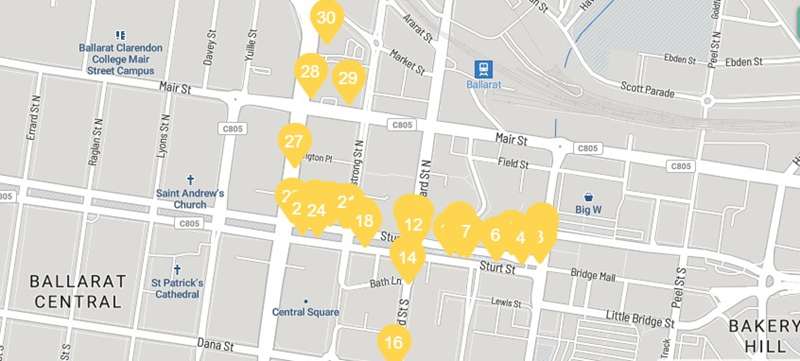
Reveal Ballarat's Past Heritage Walk Map
1. Beginnings of Ballarat
Corner of Sturt and Grenville Sts
Stand on this corner and watch as busy modern Ballarat streams down Sturt Street and around the corner onto Grenville Street; cars, buses, trucks, motorbikes pass you by, much the same way they have over the past 160 years. Before you start this journey through Ballarat's past, pause for a moment and imagine when there were no streets, no buildings, only a river which ran straight through here.
For an estimated 25,000 years the Boro Gundij clan lived here, one of the 25 clans speaking the Wathaurong language whose territory stretch from here west towards Trawalla, south into the Otways and Geelong, and east past Melton.
In 1837, a Scottish squatter named Archibald Yuille first coined the term 'Ballaarat' - joining two Wathaurong words 'Balla' and 'Arat' to mean 'resting place' - but this part of town has been far from restful in more than 175 years since...
The original Wathaurong name for the Yarrowee River was Yaramlok - it was the arrival of Scottish pastoralists who invoked the Yarrow River from their homeland which gave it its contemporary name today.
In 1851 the discovery of gold led to one of the biggest gold rushes in world history - thousands of people flocked here in search of gold within days of an announced find at Poverty Point, and the beginnings of intensive European settlement in this valley.
The mass arrival of people led to the very first major structure to be built here - a bridge crossing the Yarramlok/Yarrowee River - to which the Bridge Mall owes its name.
"Between Albert and Grenville Streets was a low lying flat through which flowed the Yarrowee, a shallow wide creek... in the creek in the middle of this swamp, the diggers came and panned off their wash dirt."
"A crude wooden bridge was erected over this swampy ground. The width of this bridge determined Bridge Street and from it came the name of this narrow street." Nathan Spielvogel
2. Alfred Hall
Grenville St
The car park and retail outlet you see were once the site of one of Ballarat's biggest Victorian era halls - that hosted Ballarat's first Royal visit, a speech from future prime minister Alfred Deakin on the need for Australia to federate as a nation - as was the venue for mayoral balls, films, performances for the South Street competitions, and Victoria's first Juvenile Industrial Exhibition.
It was big enough to fit 7,000 people - and it was built in just 7 seven weeks. Symbolically straddling the Yarrowee Creek connecting the Ballarat West and Ballarat East municipalities, the two Councils hurriedly put together plans and built the Alfred Hall in order to greet Prince Alfred, the Duke of Edinburgh for the very first Royal visit to Ballarat in 1867.
"To see the Alfred Hall in its glory, the visitor must see it at night, with its myriad gas starlights illuminating its ample space in height and breadth, in nave and aisles, and gallery, touching all its colors, pillars, arches, and flowery festoons with a radiance unknown in the garish light of day." - Ballarat Star, December 11, 1867.
The 1878 Juvenile Industrial Exhibition was the first display of trade, craft and artworks by young men and women of Ballarat, Creswick, Daylesford, Bendigo, Melbourne and other colonies around Australia, attracting more than 5,000 works of art and examples of tradecraft. It ran for 92 days and attracted an estimated 160,000 people.
Ballarat's first elected MP Alfred Deakin conducted major speeches here - in 1894 as leader of the Federation League, to a crowd of 2,000 people in the 1900s, and in 1905, as Australia's second Prime Minister. Other political leaders, including Labor leader Dr H.V Evatt, spoke here during WW1 and WW2 and later in the 1950s
The building was designed by Henry Caselli, who also designed Ballarat's fire station, the School of Mines and the interior of the Town Hall.
In 1957 the Alfred Hall was demolished upon the completion of the Civic Hall two years earlier as the city's new major exhibition and performance space.
3. Bridge Street corner
Bottom of Sturt St
Horses, trams, cars, motorbikes, shoppers - for decades this was the throbbing, noisy nexus of Ballarat's transport network and retail establishments.
From its beginnings one could wander Bridge Street and find tent and tarpaulin makers and bootmakers supplying the hopeful miners arriving on the goldfields, while watchmakers, jewellers, tailors and drapers assisted those who got lucky in spending their newly found fortunes.
Before the Yarrowee Creek was redirected underground and covered over it would periodically flood, bringing a cornucopia of flotsam including fruit and vegetables, clothes and other goods floating out of the stores and down the street.
The northwest corner, now Norwich Plaza, was home to a long line of clothing and homewares stores, including WM Bean & Son, Rose's, Morsheads and Dickins self-serve grocery in the 1950s.
The Buck's Head hotel on the opposite corner was a major landmark for more than 120 years, boasting 29 rooms, a large outdoor fernery and signature stag's heads on the walls.
Turn around and see a monument to the 8 Hour Day movement behind you. Ballarat was proud of achieving the 8 Hour work day in 1856, just two weeks after the stonemasons of Melbourne. In 1874 the Eight Hour Association meeting was held at the Buck's Head, and it was here in 1883 the annual 8 Hour day parade was conceived of, becoming for a time the biggest and most successful parade on the Ballarat calendar, with its profits funding the Trades Hall building in Camp Street in 1887.
The Buck's Head Hotel also marked the tram terminus for Ballarat from 1887 until 1937, with legendary publican Fritz Wilson known to catch the last tram home each night. In 1954 an unattended tram rolled down Sturt Street, smashing through a wall into an empty office at the Buck's Head. The hotel was demolished in 1960.
4. Sturt Street tram terminus
Bottom of Sturt St
This intersection was the terminus for the trams travelling to Ballarat East as well as those heading to Ballarat North, when Bridge Street was the biggest the retail hub of the town. At its peak the Ballarat tram system extended to Mount Pleasant, Drummond Street, Sebastopol, Drummond, Victoria, and Lydiard Street. You could catch a tram here that would take you to Lake Wendouree, where the last operating trams and track are today.
In the late 1880s the Ballarat Council decided to bring in a tram system, deciding the cable-based trams of Melbourne were too expensive, choosing instead for the horse-drawn style of trams being used in Adelaide. At its peak in the horse-drawn era, the Ballaarat Tramway Company operated 17 double-decker horse trams and one single decker unit, with 50 horses in rotation.
In 1905 the Electric Supply Company of Victoria took over the system and electrified the network, and by 1938 it was the largest tram system operated outside of a metropolitan city.
The last trams ran on Sturt Street in 1971 before the network was closed down and the tracks removed. For many years a tram shelter with a lunchroom and toilets for tram staff was located here, removed in 1923 to allow for a better view of the intersection and replaced with a smaller structure, decorated with flowers for the Ballarat centenary of 1938.
This corner was notorious for trams derailing as they came down Sturt Street and around the corner; one celebrated incident included a tram colliding with the front bar of the Buck's Head Hotel, while another ended up in the front window of Dickins' grocery, now the site of Norwich Plaza.
We're going to walk up the centre of this strip along Sturt Street now - please be careful crossing the U-turn lane - and head away from the Mall towards the 8 Hour Monument. There's a path there that will take us up Sturt Street...
5. Ballarat Star and Courier
Sturt St
Two daily newspapers located just two doors away from each other bred a keen sense of rivalry and competition for Ballarat's readers.
The Ballarat Star was begun in the wake of the Eureka Stockade by 25 men each contributing 25 pounds, The paper's namesake was the Star Hotel on Main Road, the meeting place for the Ballarat Reform League. The newspaper was intended to be a less radical alternative to the Ballarat Times, begun in 1854 and whose editor Henry Seekamp was famously jailed for sedition for the pro-miner stance of his stories.
Robert Clark and Edward J. Bateman, proprietors of the Talbot Leader, moved to town and first published the Ballarat Courier in 1867, finding huge success with an eager readership. The two papers, according to historian Weston Bate:
"...kept up a regular commentary on European and british as well as local affairs, with recurring attention to such matters as socialism, women's rights, bushfires, diseases, Henry george, morality, railway policy and forestry..." - Weston Bate, Lucky City
The Ballarat Star was initially a tri-weekly, and originally based on Little Bridge Street, but moved to higher ground on Sturt Street after several disastrous floods, and became a daily newspaper in 1856.
In its first edition the newspaper made the following pledge to its readers:
Arguments, straightforward and convincing, will be the principal weapon used by us. Candour and impartiality it will ever be our endeavour to maintain, and whilst these columns are open to all, we distinctly state that we shall most assuredly be influenced by none
In 1867 the Ballarat Courier was established on the south side of Sturt Street, but moved to this site in 1871. The building you see today is actually two Victorian buildings that have been extensively renovated over the years to accomodate new technology such as steam powered printing presses, electrification and telephones.
The Courier purchased and took over the Ballarat Star in 1923 and continued at this site until its move to the current location on Creswick Road in 1982.
The celebrated journalist and historian J.B Withers wrote for the both the Ballarat Star and the Courier as well as the Ballarat Times. He wrote the first in-depth history of Ballarat, publishing it in twelve parts in the Ballarat Star from 1870.
Thomas Bury had begun working as a journalist aged 16 on the ship from England out to Australia; he worked on the paper and then as a columnist for the Ballarat Courier through the 1870s into the 1890s. He used the alias 'Tom Touchstone' to campaign for statues of poets in the gardens of Ballarat's main boulevard. Three of the four statues he proposed are in existence today - two of them nearby on Sturt Street.
"He was one of the promoters of the Burns statue, and laboured industriously for its erection. Following this, he was a member of the Moore statue committee... he had an idea that Ballarat should raise one statue a year... in the columns of The Courier he suggested an annual carnival to be called Statue Day..."Obituary to Thomas Bury, Colac-Herald 1900
Another influential Ballarat Courier journalist was Robert Williams, who edited the Courier from 1889 into the 1900s, at the same time joining up and moving through the ranks of the 3rd Battalion (Ballarat Rifles) during the 1880s, but was denied service in the Boer War because the Courier would not release him from his position. In 1915 he was made commandant of Victoria's military and was responsible for reforming Victoria's training camps and systems during World War 1.
In 1902 he became Town Clerk for Ballarat West, and by 1906 he had conceived and lobbied for the statue of a soldier upon a horse in front of the Town Hall, commemorating soldiers from Ballarat and surrounding areas who fought in the Boer War in South Africa.
6. Sutton's House of Music
Sturt St
In 1891 this was Ballarat's tallest building, and housed Australia's first purpose-built music emporium. It's also the site of the world's first telephone network and Ballarat's first elevator. The street in front was also the scene of a near-riot when a man on a motorized trike rode into town, having made the first motorised journey from Melbourne to Ballarat.
Sutton's music emporium began when Richard Sutton sold musical instruments from a tent on Bakery Hill. After his untimely death in 1878 his wife Mary took on the business and with her shrewd business acumen moved from a one-storey business next door to this site and the building you see today.
Mary Sutton's magnificent vision for Australia's first music emporium became reality with huge chandeliers lighting a room filled with 37 different makes of piano, stringed instruments, and five leadlight windows portraying legendary German composers.
Of her five children her son Henry was to become one of Australia's greatest inventors, developing and refining the technology for light bulbs, dynamos, telephones and handsets, carburettors, halftone photo printing, wireless radio, Australia's first locally made cars - and he proposed televising the 1885 Melbourne Cup to Ballarat, three years before the inventor of television, John Logie Baird, was born. Henry would plan, build and install Ballarat's first hydraulic elevator in this building when Mary's health failed and she was confined to the upper floors.
In 1897 Henry Sutton's chief engineer John Mennie rode a motorised trike modified by Henry from Melbourne to Ballarat, accompanied by a team of cyclists. It was the first long-distance motorised journey in Australia at the time. When he arrived thousands of people had gathered on the street to see such a contraption for the first time - so much so the police were concerned windows and storefronts would be pushed in by the crowds. With concerns for safety, Mennie rode the trike straight into Sutton's House of Music, before again taking to Sturt Street to satisfy the huge crowds demanding to see more.
Alexander Graham Bell paid a visit to Henry Sutton in this building in the early 20th century, garnering new ideas on how to design and build a telephone network from the system connecting Sutton's House of Music to its workshop on Main Road.
Sutton's opened stores across regional Victoria and expanded into the new craze for bicycles, and later evolved into the Brashs chain of music stores. The Sutton building was taken over by a gas company in 1971 until the early 2000s, when it was left empty for some years before finally being re-opened as a live music venue - briefly in 2011 and then officially as Sutton's House of Music - in 2014.
7. Ferns', Phillips', Carlyon's
Sturt St
This corner is the site of a couple of important landmarks in Australian culture and history. Over decades it was the site of a hotel and guesthouse operating under various names - Fern's, Phillips and Carlyons - serving a cosmopolitan and diverse trade of visitors ranging from merchants, miners to cyclists and visiting entertainers performing at venues in town.
In 1893 a meeting in Ferns' confirmed the go-ahead from local cycling clubs to form the League of Victorian Wheelmen, the professional cycling organisation and regulating body which would become the Australian Cycling Federation.
But it was in 1886 that a meeting was held at Ferns's - which would reverberate throughout Australian history: William Guthrie Spence and David Temple chaired a meeting here after a sharp drop in shearing rates inspired Temple to travel from his home in Creswick across the region to visit shearing sheds and agitate for a united bargaining approach by the many miner/shearers.
The meeting brought about the establishment of Australia's first trade union - the Australasian Shearers Union, which became the Australian Workers Union in 1895.
Thomas Carlyon took over the lease of the hotel, for an extended time, returning to Melbourne to own and operate the huge Carlyon's Hotel on the corner of Burke and Spencer Streets, as well as buying the Esplanade Hotel in St Kilda and extending it with a ballroom.
This spot is something like the epicentre of live music venues in Ballarat - within 150 metres of this spot thousands of music students have played onstage for the South Street competitions, a generation in the 1980s and 90s frolicked at the former Camp Hotel, and contemporary venues from Camp Street to Lydiard Street and this stretch of Sturt Street continue to offer live music performances and a refreshing drink in the evening.
Carlyon's features in the diary of John Phillip Sousa on his world tour of 1911, but it's in the 1920s that sources claim a jazz record was first played in this venue - said to be the first jazz record heard in southern Australia, sparking interest that would ignite the enthusiasm of musicians and listeners from Ballarat and then Melbourne.
8. Titanic Bandstand
Sturt St
What's that ship on the weathervane of the bandstand? There is no other structure quite like this in the world - the only bandstand dedicated to the musicians who played aboard the RMS Titanic, one of the few remaining examples of Edwardian bandstands.
Musicians from the Victorian Band Association raised money to build this bandstand dedicated to the musicians of the Titanic following the ship's tragic sinking on the 15th of April, 1912. It was eventually officially unveiled in 1915, with a huge parade of brass bands along Sturt Street.
You might spot a bit of a typo on the plaque, if you're wandering around the base of the bandstand.
In more modern times, a local group of musicians gathers here at the date and time of the ship's sinking each year. They call themselves the Titanic Memorial Band. They play one song - and there is much debate about what the actual last song played on the Titanic was - to honour the memory of all musicians who have died in the pursuit of their music.
These photos were taken on the path - but make sure you walk up and into the bandstand using the path to the higher side of Sturt Street. Imagine watching hundreds of musicians marching past this location, proudly playing brassy tunes to officially unveil this unique monument, all with money they had donated.
9. Ballarat public library
Sturt St
It took almost 100 years of negotiation between Ballarat East and West councillors before one central library was established in Ballarat; in 1856 a free library was proposed, but it was 1944 when the site on this corner was finally established as Ballarat's official library.
Bickering between councillors of Ballarat East and Ballarat West Councils over which side of town the library should be located resulted in long delays for construction.
As soon as the Mechanic's Institute was established on Sturt Street, the councillors from Ballarat East withdrew their support for a free library on Sturt Street and moved to have one built on their side of town. Decades of attempts at raising funds for a free library resulted in construction of a site here in 1895, with the Sturt Street frontage sold to help fund construction costs.
Henry Caselli's grand vision for a three storey towered building complete with reading salons and smoking lounges was deemed too expensive.
From 1901 until 1965 the Ballarat library operated in the floor above the Summerscales book shop, built on the site originally set aside for the library, with a remodelling of the front of the building from 1939-41.
In 1994 the library was closed and the new Central Highlands Regional Library constructed on Doveton Street, behind the Civic Hall and Market Square.
In front you can see one of the more modern statues of Sturt Street: Point to Sky by Akio Mikagawa, installed in 2001. It was the last ever commission for the legendary Japanese sculptor, who had worked in Australia since 1974, with major public works in most capital cities. He died before Point to the Sky could be constructed, leaving his wife Carlier to complete it.
His vision was of two seeds - one golden - to symbolise the mining heritage atop a structure indicating the struggle of civilisation the legacy of the Eureka Stockade. Local people in Ballarat chose to see two footballs atop a gleaming steel pillar - and took it to signify Ballarat's own Tony 'Plugger' Lockett, Australian football legend.
10. Ballaarat Mechanics' Institute
Sturt St
Few buildings have as colourful and illustrious a history as the Ballaarat Mechanics' Institute.
It's seen a century and a half of self-starting thinkers, speakers and intellectuals pass through its library doors, as well as 150 years of live music and dancehall acts in its halls.
It also played a cameo role in the dawn and development of cinema in Ballarat. More importantly, it continues as a hub of knowledge and culture to this day.
Once there were over 1,000 Mechanics' Institutes in Victoria. Now, there are less than ten. The Ballarat Mechanics Institute is one of the few in Australia to be able to claim it has offered the same basic library service and gathering place at the same address for over 150 years.
In 1856 two main groups representing Ballarat East and Ballarat West began competing for a site, and later that year a third group, dedicated to the advancement of humanity, posted the following plea in the Ballarat Star:
"...We have casinos, dancing and concert rooms, to the heart's content - but, to say the least, there is but little to be found there to satisfy the thoughtful mind eager for instruction. I am greatly mistaken if there are not some hundreds on Ballarat who would rejoice at having opened to them some means whereby their mental and moral nature would be improved and benefited." Ballarat Star, 1856
In 1859 two men stepped in to end the feud: JB Humffray established Ballarat's first Mechanic's Institute in 1859 in an upper floor of the Ballarat East fire brigade tower. Thanks to the efforts of former Eureka leader now Victorian MP Peter Lalor, a site was selected on Sturt Street for a purpose-built Mechanic's Institute.
It's the library where a young Henry Sutton would eagerly devour every new scientific and technical publication that came in during his youth; where Mark Twain presented his lecture when he visited in 1895; where some of the first moving pictures were exhibited; and where fledgling independent film-maker A.C Tinsdale and the Austral Photoplay company would begin (but never finish) production of a Ballarat-made feature film called Women and Gold in 1917.
From 1931 to 1957, the first musical director of the ABC and the instigator of state-based orchestras, Ballarat-born William James, presented many concerts here of international and prominent Australian musicians backed by ABC orchestras.
After many decades of operation as a cinema, the Ballaarat Mechanics' Institute has in the recent past resumed musical performances, exhibitions, speeches and presentations. Nowadays you can come to the Mechanics' and see everything from public talks on history, science and biography to Ballarat Foto Biennale exhibits and concerts for hardcore punk bands and the Ballarat Slow Music Festival.
The Institute houses a stunning heritage library and the beautifully restored Minerva Room, pictured here in these illustrations from the 1860s.
11. Robbie Burns and Loafers' Tree
Sturt and Lydiard St Intersection
Walk up from the Titanic bandstand to the intersection of Sturt and Lydiard. There's a few important memorials to take in; for the establishment of free speech, for the recognition of the great poets, and for one of the most infamous expeditions of exploration in Australian history.
The Loafers' Tree was Ballarat's version of the original Speakers Corner in Hyde Park, London, established in the wake of 'freedom of speech' being declared a basic right - a place where public speakers may hold forth on any subject as long as it is considered lawful.
Where the Burns statue now stands, there grew, in the late [1870s], a large willow tree under the shade of which was a wide seat, where on sunny afternoons gathered all the amateur politicians, and loudly denounced the doings of the Berry and other governments. This tree was rudely known as Loafers' Tree. - Spielvogel papers
Ballarat's Loafers' Tree came about after the establishment of a Speaker's Corner in The Domain in Sydney in 1878, and in Birrarung Marr in Melbourne in 1889.
The statue honouring Scotland's great poet Robbie Burns came about by a call for private subscription, to which a sizable portion of Scottish immigrants in Ballarat contributed. Ballarat-based artist Thomas Thompson designed it, sculptor Giovanni Udny, working in Carrara, Italy, was commissioned for the job and the statue was shipped to Ballarat and unveiled with great ceremony in April 1887.
"There is another singular coincidence in the placing of Burns' statue in Ballarat, and that, too, beside the willow tree which now partially veils the marble, to the annoyance of the public. Many years ago Mr Thomas Lang, of the firm of Lang, Rennie,and Co., brought out some slips of Kilmarnock willow, which he planted in Ballarat, and which look so beautiful now around our lake. The tree beside which the statue of Burns is erected is thus a lineal descendant of one of the willows under which Burns often reclined when his 'poet's eye was in a fine phrenzy rolling.' It is surely strange that, here at the other side of the world, the statue of this Kilmarnock man should have , thus been erected beside a Kilmarnock wil low tree, and that without design..." - letter to editor, Tom Touchstone, Kilmore Free Press,1887
'Tom Touchstone' was the pseudonym for Thomas Bury, a columnist in the Ballarat Courier during the 1870s into the 1890s who first publicly campaigned for statues honouring the national poets of Ireland, England and Australia as well as Scotland.
You can see the Thomas Moore statue not far from here - and somewhere else on this tour we'll find where the statue of William Shakespeare ended up...
12. The Corner
Corner of Sturt and Lydiard St
During the 1860s this corner ranked among the world's busiest financial hubs; known simply as The Corner, hundreds of gold speculators, dealers and agents would cluster here and vigorously engage in the business of trading in mining stocks and ventures.
This was originally an informal meeting place front in of Stallard and Goujon, the first stockbrokers to set up shop on this corner. The first official stock exchange was a shed over a mineshaft on the site now occupied by Her Majesty's. This was followed by a larger exchange occupying the Unicorn Hotel and Ballarat Mechanics' Institute, before the bigger Ballarat Mining Exchange was built in 1887.
"When the rich gutters were nearly worked out, and the large original shares had got reduced to scrip, share dealing became a larger and livelier business, and brokers and jobbers multiplied, nearly all of them being, for the first few years, men who had been actually engaged in mines as working or sleeping shareholders. The business was accompanied by projection of new ventures, and the occasionally violent alternations of activity and depression which usually mark the course of share dealing, for promoters of new schemes have to live, if they can, by their craft, and the passion for scrip gambling provided an ample arena for their exploits." - History of Ballarat - J.B Withers
This was the place not just where money was invested, but where the first news of gold finds was hollered out to clustered groups of miners and speculators amidst robust questions and discussions of the quality of the finds.
In 1966 the original London Chartered Bank building was demolished and was replaced by this modern bank building.
13. Burke and Wills statue
Sturt and Lydiard St Intersection
Across Lydiard Street opposite the statue of Robbie Burns is the monument to a very Australian story. The 1860 Burke and Wills expedition, which sought a route from Melbourne to the Gulf of Carpentaria in Australia's far north, has a Ballarat connection.
Dr William Wills, the 2nd in charge and the astronomical and meteorological surveyor for the expedition was something of a local. He learned trigonometry, Euclid drawing and geometry working in the Ballarat Survey office, initially having worked as a gold digger and then at his father's surgery practice on the Ballarat goldfields in the 1850s.
Following the tragic demise of all but one person on the expedition, a massive clocktower and monument to the expedition was proposed on this site. A public call for subscriptions to raise the 200 pounds required for the grand structure yet only managed to raise 79 pounds. In 1866 a new push to complete the monument began again; the monument before you was unveiled the following year.
The only survivor of the expedition, John King, had his name added to the monument only after his death in 1872. In the mid 20th century this corner became a popular late-night gathering place, with hot pies and snacks for sale from a mobile cart for late night revellers.
In 2011 a time capsule interred at the time of the monument's construction was opened, its contents found to be a collection of coins, a copy of the Ballarat Star and a bottle of spirits, now broken and its contents long spilled out. The same year a new time capsule was placed in the monument with its opening date set at 2111.
14. Her Majesty's Theatre
Lydiard St Sth
It's time to leave Sturt Street - walk past the bank on the old Corner and up Lydiard Street to find Her Majesty's Theatre. This is one of the very few theatres in Australia that can claim to have been operating continuously for more than 140 years as well as having its own subterranean organ. The picture revealed here is a peek under the ground you are standing on - just a part of what lies under this theatre. This building was originally opened as the Academy of Music, replacing the Theatre Royal on Sturt Street as Ballarat's principal live venue.
While maintaining a long and rich career of featuring professional acts ranging from opera to ballet, jazz, rock'nroll and comedy, Her Majesty's Theatre has become synonymous with the South Street Competitions, Australia's largest and oldest continuing eisteddfod. South Street began as a debating competition in 1891; it now runs for several months each year, attracting hundreds of performers from across the nation to compete in all manner of solo and group musical performances, debating, dancing, calisthenics and the renowned Herald-Sun aria competition.
James Scullin, Alfred Deakin, Dame Kiri Te Kanawa, David Hirschfelder, Joan Kirner, Denise Drysdale, Adam Simmons - just some of the names who once walked onstage for the South Street competitions, although just about every musician ever to hail from Ballarat has his or her own story of a first performance onstage at Her Majesty's for South Street too.
One of the theatre's greatest assets lies hidden underground, taking up the width of this city block; the Compton Organ. The organ was built in 1937 and purchased in 1972 from the Ritz Theatre in Lancashire, England.
The several tonnes of pipes, vents, bellows and pre-solid state technology were installed by the Ballarat Organ Association over 10 years and finally unveiled after lengthy interior works were done to the Theatre to fit them in. It's one of only two subterranean organs in Australia, rising out of the orchestra pit on a hydraulic lift.
Throughout the year Her Majesty's maintains itself as one of Victoria's major regional theatres, hosting performances from the likes of Dame Kiri Te Kanewa, Paul Kelly, Tommy Emmanuel, visiting international comedians, and a regular schedule of dramatic and musical theatre shows.
15. Ballarat School of Mines
Lydiard St Sth
Today it's a campus of Federation University and home to a technology park for IT and communications businesses. In the past it has also served as the site of Ballarat Museum, the Ballarat Gaol, and birthplace of Ballarat's biggest and most popular brewery and the famed Ballarat Bertie brand.
It was the site for Ballarat's gallows and numerous public hangings; the infamous bushranger Captain Moonlite escaped from here in 1872 after cutting a hole through a wall, capturing a warden and releasing seven other prisoners before escaping over the wall using a blanket rope.
On one side of this pedestrian-only area you can see a giant iron door and guard towers above a bluestone wall. That's the old Ballarat Gaol. The big chimney to the right is the former Ballarat School of Mines Brewery complex, a bluestone and brick complex designed by Henry Casselli, engaged by the partnership of beer brewers William Tulloch, James Coglan and hotel owner Alexander McLaren. In 1857, a partnership was formed that merged their interests in three breweries and more than 90 hotels, officially becoming the Ballarat Brewery in 1895.
The School of Mines Ballarat was the first of its kind - now the third oldest tertiary education institution in Australia - originating in 1870, inspiring similar Schools of Mines across the nation. It was conceived principally as a vocational institute, training students in the practiucal crafts and techniqus of mdoern mining.
The remaining chimney was rebuilt as the Brewery Complex by the School of Mines, containing classrooms and lecture theatres; the School of Mines Complex now houses tech and communications companies, as part of the Ballarat Technology Park.
16. Ballarat street lights
Lydiard St Sth
What does this roundabout have in common with Buckingham Palace? They both share the same kind of lighting - although Ballarat's need for large street lamps was more about safety than ornate decoration. One of the constant risks in a mining settlement like Ballarat was of falling down a mineshaft - particularly at night. For those wanting to walk in search of entertainment in the evening, the practice of walking around the blocks in street light became a form of social entertainment itself. There were deep mines in most of these blocks at one time or another; Ballarat’s central blocks could be just as treacherous underfoot as the more heavily mined areas.
In 1881 the City of Ballarat introduced 20 gas lamps - this is one of two 'original' Sugg lamps in Ballarat (the other one is at the junction of Sturt and Grenville Streets), the oldest of their kind in the world. It is particularly rare because these English 12 sided lamps were built large enough to house candles, pre-dating piped gas systems when street lights became much smaller. In 1807 William Sugg became the first person to make and lay a gas pipeline for lighting, and the Sugg company which designed and manufactured gas lighting was for a time one of the biggest such companies in the world. Sadly there is very little photographic evidence of Ballarat's gas lights from the 1880s; the 'before' picture you see is of a workman about to install the gas mantle in a Sugg Lambeth lamp. The City of Ballarat replaced the Sugg lamps with the introduction of electric lighting in 1904, but in the 1980s ordered the restoration of its street lamps and had these recreations installed. Meanwhile the tradition of a roll around the block as a form of social entertainment continues to this day - both on foot and via horseless carriage...
17. Craig's Hotel
Lydiard St Sth
Craig's is one of the most historic hotels in Ballarat, and is significant as the site of the Royal Commission into the Eureka Stockade, a temporary Ballarat Town Hall, the scene of a huge ball with fugitive American Civil War fighters, the workplace of famed poet Adam Lindsay Gordon, resting place for the visiting Mark Twain, and birthplace of the Melbourne Racing Club, originators of the Caulfield Cup.
Originally built and opened as one of the earliest licensed premises as the Ballarat Hotel in 1853, Walter Craig purchased the building from Thomas Bath and re-opened it as Craig's in 1857.
In 1865 the sudden arrival of the CSS Shenandoah, a Confederate cruiser running as a pirate raider in the US Civil War, docked in Melbourne, and a delegation of officers headed to Ballarat
The wealth, beauty and fashion of Ballarat were out in full force... every attention that kindness and courtesy could suggest was shown us, and more than one heart beat quicker at such convincing evidence of the existence of sympathy in this country of the Antipodes, for the service in which we were engaged. Many a grey uniform coat lost its gilt buttons that night, but we saw them again ere we bade a final adieu to Australia, suspended from watch guards depending from the necks of bright-eyed women..." Cornelius Hunt, The Shenandoah
But it was the brief stay of Adam Lindsay in Craig's stables along Bath Lane that links this street to one of the greats of Australian literature. Adam Lindsay Gordon, known later as the 'national poet', moved himself, his wife and his newborn daughter to live in a cottage here after living in Robe, South Australia.
In 12 turbulent months from November 1867 he rented the livery stables business with a partner, he suffered a head injury from a horse, his newborn daughter died, his business failed... and finally he won three races at the Melbourne Hunt Club steeplechase meeting in October the next year.
His original cottage has been preserved in the Ballarat Botanical Gardens, and Craig's is preserved in Adam Lindsay Gordon's poem Banker's Dream:
At the road once again, pulling hard on the rein, Craig's pony popp'd in and popp'd out ;I followed like smoke, and the pace was no joke,For his friends were beginning to shout.
At Craig's Gordon was also a close companion with the brother of Herbert Power, who was one of the six thoroughbred owners who gathered at Craig's Hotel one night in 1875 and formed the Victorian Amateur Turf Club.
The first Victorian Amateur Turf Club race was run at Dowling Forst, outside of Ballarat - before moving to Caulfield, and becoming the Caulfield Cup.
There's local talk of a ghost and things that go bump in the night in the cellars of Craig's... and there's the legend of the hotel's namesake - and his love for racehorses - which lingers...In 1870 Walter Craig was said to have dreamed of his horse Nimblefoot winning the Melbourne Cup, but in the dream when he approached the rider was wearing a black armband.Sure enough, Walter Craig's horse Nimblefoot won the Melbourne Cup in 1870 - some three months after Walter Craig died. The jockey wore black armbands to mark Craig's passing.
Have a wander down Bath Lane to see the doors to the original stables, and then we head back down Lydiard Street and back onto Sturt Street for our next stop at the Town Hall.
18. Town Hall & Alfred Bells
Sturt St
The Ballarat Town Hall was constructed according to the designs of three architects following a competition in 1868; the first wooden Town Hall had burned down in a fire and the initial proposal for a replacement building was deemed too costly. Inside the tower are the eight Alfred Bells, which have chimed out across the town ever since Christmas Day in the 1870s.
One story told about the Alfred Bells is that they were ordered and purchased from England by a councillor because his wife missed the sound of church bells; the truth is somewhat darker: historian Weston Bate points out it was a public gesture by the people of Ballarat following an attempted assassination of a member of the Royal family.
"Those bells rang out an astonishing postscript, for they were a public penance for the fact a Ballarat man, HJ O'Farrell, a demented, alcoholic Irish-produce dealer from the Market Square, shot the Duke in the back (fortunately hitting his braces) during public picnic in Sydney on Thursday March 12, 1868" -Weston Bates, Lucky City
Henry James O'Farrell had aspired, and failed to be ordained as a minister of the Church. He worked at Clunes as a farmer and had been working as a grain merchant in Ballarat, last seen at Market Square, before travelling to Sydney to prepare for ordination. It was there that he shot at the Duke. Despite clear indications that O'Farrell was suffering a mental breakdown at the time he was found guyilty and hanged.
In Ballarat the town's memories of its recent celebrations for the Duke's visit appeared to heighten the shock and outrage at the news of the assassination attempt - subsequently a call was made for public subscription to raise money for a set of bells dedicated to Prince Alfred. The four and a half tonnes of bells were commissioned and cast at the Mears and Steinbank Foundry in Whitechapel, London.
In 1981 the bells were removed and sent back to the Whitechapel foundry for recasting and re-installation in a new steel frame in the Town Hall tower. This is one of three Town Halls in the world equipped with its own bells - and most likely the nly one in the world to have been designed by three architects - the exterior by JJ Lorenz, the interior by HR Caselli, and the whole thing brought together by Percy Oakden.
The eight bells can be rung in 5,040 different permutations - ringing all permutations without repeat or error has only been successfully done three times in Ballarat's history and is an evergreen challenge to bellringers and all campanologists.
19. Royalty in Ballarat
Sturt St
There have have been several Royal visits to Ballarat, beginning with the Duke of Edinburgh Prince Alfred's visit in 1867, followed by Prince Albert Victor and Prince George of Wales in 1881, the Duke of York (later King George V) and his duchess in 1901, the newly coronated Queen Elizabeth II in 1954 and Prince Charles and Princess Diana in 1983.
This statue of Queen Victoria was commissioned in 1897 to mark Queen Victoria's diamond jubilee, unveiled before a crowd of 20,000 people, and the square where the statue resides was named Victoria Square.
Besides the ignominy of being the home of the attempted assassin of the Duke of Edinburgh in 1867, Ballarat was also scene of a security incident during the visit of Prince Charles and Princess Diana in 1983, when an eager train driver found himself at gunpoint, having surprised the Royal couple in his haste to greet them
It is a little known fact but there was a moderate to serious breach of security when the Royal Train reached Ballarat. As no formal introduction had been arranged between the locomotive crew and the Royal Party, Driver Bill Steedman decided to take matters into his own hands. He leaped off S300 upon arrival, exited the No.1 platform at Ballarat by jumping over the platform fence near Lydiard Street and ran around the back of the station. As the Royal Party were leaving the street side of the station entrance, Bill rushed towards HRH The Prince and Princess of Wales to introduce himself. The Royal couple were rather startled by the approaching stranger and for just a few moments Driver Steedman had loaded firearms aimed at his person by security personnel.
Golden Steam of Ballarat, King & Dooley
20. Phoenix rail remnants
Sturt and Armstrong St Intersection
To find this spot you need to be on the footpath of the central Sturt Street gardens opposite the bank, diagonal to the Town Hall. This is where we'll view the next couple of sites. Be careful crossing the street!
This one small remaining track embedded in a footpath is evidence not just of the famed trams of Ballarat - imagine gleaming new locomotives steaming slowly across this intersection, newly built at the Phoenix Foundry on Armstrong Street, on their way to the Ballarat railway station.
At one time employing more than 500 people as well as fielding its own football team, brass band and amateur theatre troupe, the Phoenix Foundry was a sprawling complex, taking up the width of a city block from its front doors on Armstrong Street to its warehouses and loading docks on Doveton Street.
It became a huge supplier of the local mining industry, forging tools and building machinery, but is best known as Victoria's first train manufacturer, responsible for more than 300 locomotive engines as well as rolling stock and carriages; much of the iron used was sourced from the nearby Lal Lal Iron Company.
In 1871 the Phoenix Foundry won the first contract in Victoria to manufacture trains for the Victorian railways; previous trains had been reconstructed from parts brought in from interstate. For the next two decades all trains on Victorian lines were built here, and passed this point on their way to service on the Victorian rail network.
The buildings are spread over a wide area of ground, and 130 men and lads were at the machines, the blacksmiths' fires, or in the blastinghouse. Three locomotives stood in a partly-finished state in the largest building. One had all its parts fitted into position, and needed but a few little things to render it complete. A glance from the complex mechanism, with its multitude of rods and bolts and fastenings, and its capacious boiler, to heaps of scrap iron and unshapely plates of the same metal, the raw material out of which all the parts had been constructed, at once prepared the visitor to expect a large variety of machines for cutting, rounding, piercing, planning, smoothing, and even polishing iron The Argus (Melbourne, Vic. : 1848 - 1956), Thursday 3 April 1873
In 1882 the Phoenix Foundry applied to Ballarat Council to have a rail line installed along Armstrong Street to allow locomotives to be rolled across Sturt Street and down to the railway station rather than be 'transported by steam tractor'. You can find the only remains of the Phoenix Foundry complex in the Phoenix Mall outside the entrance to the shopping centre - the base plate of the turntable used to allow the massive locomotives to turn on to Armstrong Street.
The arrival of the 100th engine on April 13, 1883, was celebrated with a public holiday in Ballarat, a special train covered in flowers and bouquets bringing the Premier, Ministers and other MPs to the celebrations, with thousands of people turning out to hear railway brass bands and cheer the leading hands of the foundry. In 1885 local concerns over being under-bidded on train contracts by the newly built Government rail works in Newport, Melbourne peaked with a protest meeting at the Alfred Hall, attended by an estimated 2,000 people. In 1905 the Phoenix Foundry went into liquidation; by 1906 the foundry had closed and redevelopment of the furnace and workshops commenced.
One remaining Phoenix stationary engine is in use at Sovereign Hill powering the gold mill, with one remaining locomotive, the Y-112 built in 1889, owned by the Ballarat Historical Society, maintained and operated by Steamrail. It was originally held at Ballarat East while it was being restored, but in a last twist of irony now resides at Steamrail's facility at Newport.
21. Crocker's
Corner of Sturt St and Armstrong St Nth
Established in 1862, this building was originally the Hall of Commerce. In 1865, it was a hive of retail activity, including a boot and shoe department and an under-clothing and baby-linen department run by "experienced and attentive ladies."
The sign on the wall said it all:
'CIVILITY AND ATTENTION IS THE ACKNOWLEDGED RULE OF THIS ESTABLISHMENT'
George Crocker came to Australia from England, aged 15 - later serving two one year terms as a Ballarat mayor, in 1912 and 1919. He purchased the Hall of Commerce in 1876, and established what was a classic Victorian era department store, Crocker's, which would operate for the next 130 years
He had ten children with his wife Clara Walsh ; 6 daughters and 4 sons. Two of their sons would die in the First World War.
The shop had an old-world charm with wide counter edged with tape measures and an aerial cash carriage system whereby cash payments were placed in a small canister and sent flying up to the cashier perched in an eyrie near the ceiling.
In later years it moved into a smaller premises next door and remained managed by descendents of the Crocker family until 2011.
22. Criterion/Tunbridges/Lester's
Corner of Sturt St and Armstrong St Nth
The building on this corner began its life as Criterion House, before growing from a drapery into a three story department store alongside one of the more famous hotels in Victoria. Imagine now a first floor verandah for a three-story building on this corner, people reclining on lounge chairs with a refreshing drink, while a busy department store operates next door...
David Jones, a draper from Somerset, opened his business on this corner a couple of years after his previous Main Road business burned down in 1858, calling the grand two story building Criterion House.
This palatial business building is the finest retail shop in the colony. Not even in Melbourne can its equal be found."Ballarat Star, 1861
It is said that Mr Jones was a bachelor that lived above his shop, entertaining celebrities from the stage who visited the city including 'Madame Caradini, Armes Beaumont, (then in his prime), Montgomery and others.'
Alongside Criterion House were Cafe Tortoni and the Rainbow Hotel, before 1862 when the grand Lester's Hotel was opened.
The leasee of the Rainbow Hotel before it became Lester's was T.S Bellair, an established actor from England, who had moved to Sydney in 1853 to take up a two year acting engagement with the Victorian Theatre in Sydney.
Mr. Bellair will be remembered by old Victorians us a sterling actor, who made his first appearance in Melbourne, at the Royal, as Gratiano in the " Merchant of Venice," Mr. Bellair joined Mr. Coppin in the Olympic Theatre... and afterwards became joint lessee with Mr. W. Hoskins of the Theatre Royal, Ballarat. After that Mr. Bellair was the first lessee of Lester's Hotel, Ballarat, which he kept for eight years, on leaving which he took a dramatic company to Calcutta... "Wagga Wagga Advertiser, May, 1893
Alfred Lester had worked as publican of the Free Trade Hotel in 1856, near the site of the Eureka Stockade, before taking over the moving alongside Criterion House as licensee of what became Lester's Hotel in 1861.
In 1881 the Tunbridge's Furnishing Arcade, an extension of the Tunbridges timberyard on the corner of Doveton and Sturt Street replaced Criterion House. A small factory complex bwas uilt behind the buildings where a small team of upholsterers, cabinet makers, and French polishers and mattress makers worked.
In 1916 the new owner of Lester's, L. Remington surrendered the liquor license for the building, owing to economic depression and downturn in business. Several shops as well as a Returned Soldier's Institute to help the war wounded back into civilian life opened in the hotel's buildings. In 1920 Tunbridge's purchased the Lester's Hotel buildings at auction.
By 1900 both buildings had grown to three storeys high; some 60 years later they were demolished.
23. Red Shop Tea Rooms
Sturt St
Two bakers working in the Hope Bakery in nearby Seymour Street moved here and formed a partnership, Anderson and Briant Pty Ltd, before opening the Red Shop Tea Rooms in the 1890s. They created a grand and elegant eatery and bakery with cakes, pies, desserts and all manner of confectionery prepared and baked on the premises for nearly 70 years.
Our refreshment rooms are complete with every convenience. Electric radiators, small and large tables with a nice staff of waitresses to attend to your wishes.Our Factory is the Largest for Pastry in Ballarat... and comprises cake machines, sponge mixers, meat machines, pie machines, cochlea and icing machines and a complete for ice cream. Our decorating surpasses anything in Ballarat."Advertisement, Berringa Herald, 1917
In later decades a new generation and legacy of hospitality began - the Eureka Bistro is now marking over 40 years of cooking and serving Italian cuisine as well as making and serving pizza the Australian way...
24. Theatre Royal
Sturt St
The roaring goldfields of the 1850s made noise in some spectacular theatres along Sturt Street. In 1858 the Theatre Royal opened, declared by journalist and historian Nathan Spielvogel to be "..considered the finest theatre in Australia."
The entertainment on offer included live musical performances and plays, including shows written and performed by women such as The Stagestruck Digger, by Mrs T.A. Hethrington, and other slightly different shows, such as 'Marsh's Juvenile Comedians - 'A Company composed of little Girls and Boys under 13 years of age.."
It wasn't all refined culture and light entertainment at the finest theatre in the colonies...
A letter from 'Whittington and Lovell, Managers Marionnette Company' was published in the Ballarat Star explaining their perspective of the 'Riot at the Theatre Royal, Ballarat'.
"It was impossible for us to go on the stage to offer an explanation or to expect any one else to run the risk of having their heads broken with a lemonade bottle or other missiles. The disturbance originated in the gallery from a mob of larrikins..."The Argus - 1877
With the opening of her Majesty's Theatre on Lydiard Street midway through the 1870s the Theatre Royal was considered to be surplus to needs, closing in 1881.
25. Block Arcade
Sturt St
It was a meeting place as well as retail hub; stretching from Doveton Street down to Armstrong Street the Block Arcade's walls were lined with lead-light windows above and penny slot machines, weight machines and novelty mirrors below.
The shops inside included sellers of shortbread biscuits, cakes and sweets, a stamp shop, florist, dressmakers and the much loved Bill's Book Bar; over time it connected O'Farrell's horse bazaar, the Lucas underwear factory, a supermarket, a Ford service centre, a car wash and the Stork Hotel , which was purchased by Myer's in 1954 and incorporated as part of the store.
In 1931 a refurbished Block Arcade was re-opened to the public. Today the Arcade has been replaced mostly by two department stores, but there's still a smaller arcade of shops and the 1930s Art Deco facade facing Sturt Street remaining.
26. A frosty tradition
Sturt and Doveton St Nth Intersection
Throughout Ballarat's history it has been known to get a bit chilly from time to time...
Although not a seasonal happening, it may or may not surprise you to know that Ballarat gets cold enough for snow to fall - sometimes during winter, sometimes during a cold snap as late as November - turning Sturt Street into a picturesque landscape resembling perhaps something a bit more European in nature. (Of course if it's snowing and you are on Sturt Street a person will probably walk past you in either shorts or t-shirt to remind you that you are in Ballarat...) It snowed here on Christmas Eve, 1901, and in the past few years it has snowed once or twice per year in the colder months - but never quite as heavy as it appears in photos from the 1800s and 1900s. Chances are it will snow here again - if you capture photo of a snowfall in Ballarat please feel free to share it with everyone at #ballaratrevealed
27. Horsepower on Doveton St
Doveton St Nth
This part of Doveton Street is around the corner from the former horse cab ranks on Sturt Street which stretched down to Armstrong Street until being removed in 1897 and replaced with flowerbeds. All manner of equine-related businesses operated in this street; saddlery, livery, stock and station agents and feed all bustled with business.
The street was routinely filled with hundreds of horses and horse-drawn vehicles headed into and out of town, and on occasions such as the annual Horse Parade, pictured here, it got even busier.
In the 20th century it was horsepower of an entirely different nature which would make this place special, however.
Look around this section of footpath and you'lll spot a small plaque marking the site of Grantner and Irving's motorcycle shop.
Phil Irving was the son of a veterinarian in the Western districts, growing up fixing his father's four motorcycles used for making house calls. He cut short a scholarship to the Melbourne Technical College (RMIT) in mechanical and electrical engineering when he found work with an engine manufacturer; in 1926 he returned to Ballarat and started a motorcycle shop, specialising in building and repairing engines but was forced to close after couple of years due to harsh economic times.
Phil moved to England in 1930 by hitching a ride as pillion passenger and mechanic to Scottish engineer John Gill on the return leg of his UK to Australia round trip on a sidecar motorcycle.
Phil Irving's impact on the world is best described as being the man who invented the modern V-Twin motorcycle engine and the Brabham Formula One V-8 racing car. Motorcycle enthusiasts know him as the engineer behind the Vincent Rapide, Black Shadow and Black Lightning motorcycles; his columns and books were very popular and he was awarded an MBE in 1976 for "services to automotive engineering". Having returned to Australia many years ago he died aged 89, working on engines in a Harley Davidson store in Ballarat.
He is remembered by a plaque here - and by the Confederation of Australian Motor Sport, naming its highest engineering accolade the Phil Irving Award, and by the Phillip Island motorcycle race organisers who run the annual Phil Irving Trophy race.
28. Market Square
Corner of Doveton St Nth and Mair Sts
For nearly a century this corner was a thriving market in livestock and produce serving Ballarat and the broader region, before being replaced with the building of the Civic Hall in 1955.
"By 1878, twenty years since it's inception, the Haymarket had grown from a virgin piece of land that was surrounded by a white tent town into a sophisticated centre of trade open seven days a week. The air filled with lively banter between agents, farmers and other commercial interests as they traded their wares. Sights, sounds and smells and an amalgam of factors nurtured the economic heartbeat of the town." Peter Butters, Recollections
It was not only livestock and produce on sale in Market Square; four hotels, a chemist, an ironmonger, sadlers and a timber merchant were clustered around this site, with one advertisement from 1865 offering the following services in the Medical Hall in Market Square:
"'Teeth extracted, scaled, and filled with gold, silver or enamel with the utmost care and skill."
In 1940 a referendum was held in Ballarat, asking people if they wanted a new building on the site of the now old and decrepit Alfred Hall; the answer was "yes", although the outbreak of war put a hold on the plans. In 1951 the Council applied to rezone and redevelop Market Square; in 1953 work commenced and in 1956 the Civic Hall was officially opened.
It was one of the first steel-framed building constructed outside of Melbourne, as well as utilising 580,000 locally made bricks and 12 foot planks sourced and sawn in the Otways. The main hall could seat 1,500 people or be turned into a giant dance floor; a smaller hall built below could accomodate 440 people.
It became one of the most bustling music, community and social hubs in post-war Ballarat, hosting school functions, Ballarat Base Hospital balls and auxilliary events, election meetings, symphony concerts, debutante balls, as well as the legendary 60/40 dances, one of the very popular regular social events through the 1960s as rock'n'roll swept through Australia.
In later decades of the 20th century the Civic Hall became Ballarat's major live music venue hosting Australia's biuggest bands and visiting international artists, including AC/DC, Cold Chisel, the Skyhooks, the Divinyls, INX, Midnight Oil as well as the Australian Jazz Convention.
The last event held here was a Mayoral Ball in 2002; a community process is underway to determine the re-development and re-use of the building and site.
29. Ballarat Baths
Corner of Mair and Armstrong Sts
Walk down to the corner of Mair and Armstrong Streets and look over the skate ramp or the Aboriginal flag flying over the Ballarat Aboriginal Co-op; that was once the site of Ballarat's very own Turkish Bath House. Bathing and swimming are not just popular pastimes in Ballarat - one year after Australia's first Turkish Baths opened in Sydney, the Ballarat Turkish Baths opened to the public in Armstrong Street, serving an public health purpose for cold, dusty and dirt covered mining folk living in tents and other places not served by hot water. In 1866 a person could pay one pound a month people to have access to 'Turkish, shampooing and hot baths'.
As the Ballarat Star put it:
"Living as we are, in a highly artificial mode, the ordinary functions of the body have not the chance of maintaining us in a thorough state of health....The peculiar employments of a very large proportion of inhabitants of this district together with the exigencies of the climate and the deficient character of house accommodation, render personal absolution a matter of great importance and difficulty and it calls loudly for amelioration and remedy. "The Ballarat Star Februray 1862
Ironically the Victoria-era Turkish Bath owed more to Rome than to Constantinople; the bather was enveloped in hot dry air, not humid or moist air, in rooms of progressively hotter temperatures, and followed it with a plunge in cold water and a massage.
The Ballarat Turkish Bath Company was part of a fascinating trend in colonial Australia, pre-dating establishment of similar businesses in Melbourne. The baths were located across from the Haymarket, complete with dressing rooms and both a 'frigidarium' and 'tepidarium' - cold pools and heated pools - taken from the Roman tradition.
Turkish baths and vapour baths (saunas) were available, with hot baths offered at first, second and third class rates. Women were offered separate bathing sessions on Monday nights from 8-10pm and Thursdays from 10am until 3pm.
The Turkish Baths operated until 1867 - during the 1860s women of Ballarat signed a petition asking why men were receiving discounted entry on Mondays:
"Your petitioners, whose names are undersigned, respectfully intimate that the partiality of present shown to the Male Citizens of Ballarat in allowing them the priviledge of using the Baths on Mondays at half the usual prices, whilst your petitioners are charged the full rates, seems to them very unfair, and not in consonance with the usual gallantry of the gentlemen to whom this is addressed, and they believe that they have only to present their humble request, that the like priviledges (or as much in access as you may be pleasing to yourselves to grant) may be extended to the female portion of this Community (who may probably require and enjoy a bath as much as their natural protectors) in order to have it granted."
In 1864 the Turkish Bath Company became the Ballarat Bath Company, and a swimming pool installed alongside the Turkish baths on Armstrong Street.
In 1913 Ballarat opened the first public baths for children on Pleasant Street, claiming to have initiated a nationwide movement for building public pools for school children, and in 1928 remodelled as the Ballarat City baths, with further works in the 1930s.
The Turkish Baths later became the Ballarat City Baths and modernised with a new filtration plant in 1948, after many years of complaints and attempts to resolve the issue of keeping the water clean.
Mr N F Spielvogel, president, told Ballarat Historical Society last night that as long ago as 1894 swimmers had complained about the dirty water in the baths. The city council then obtained five tons of salt from Geelong and forwarded it to the baths curator. When this supply ran out he would have to provide a further supply
30. Central Highlands Library
Doveton St Nth
Ballarat's main library was built in 1993-4 and holds the collection of the former Ballarat library located in Camp Street and founded in 1887. The Central Highlands Regional Library was formed as a shared services consortium representing 12 councils and shires in the 1950s. The other library collection in Ballarat is the Mechanics Institute and Federation University (Ballarat) library.
The foundation stone was laid on 30th July, 1993 by councillor James W. Coglan, Mayor of the City of Ballaraat along with councillor William M. Flynn and officially opened on the 20th September, 1994 by Victorian Premier Jeff Kennett.
Inside you'll find the Australiana Research Room, with access to centuries of Ballarat newspapers, original documents, maps and manuscripts; historic photos and copies of books with 'lost' information you can't find on the web.
The Ballarat Revealed Website has wonderful historic photos and a facility to show what sites looked like in the past and now.
Location
Cnr Sturt Street and Grenville Street North, Ballarat 3350 View Map
Web Links
→ ballaratrevealed.com/locations.php


