Ballarat Chinese Heritage Trail


The Ballarat Chinese Heritage Trail identifies sites that are rich in detail on the Chinese in Ballarat in the 19th century – before, during and after the Gold Rush. There are original sites, such as the cemeteries, and contemporary sites, such as the Open Monument.
A feature of this Heritage Trail is that many of the sites are open access. Sovereign Hill, the Australian Centre for Gold Rush Collection and the Xin Jin Shan Library have designated opening hours.
The Chinese in Ballarat
In 1854, not long after the news of the Gold discoveries in Victoria reached the British colony of Hong Kong, large numbers of Chinese miners began to arrive to seek their fortune on the Gold Fields. Unlike the Europeans who paid their own way to the diggings, the Chinese were mostly indentured to wealthy Chinese from Guangzhou (Canton) and Hong Kong. Many, also, were sent by their villages and families in the hope of striking it rich in the New Gold Mountain.The Chinese, who came mostly from the four counties of Taishan, Xinhui, Enping and Kai Ping south of Guangzhou, never intended to stay in Australia much beyond the period of their indenture. The miners were not the first Chinese in rural Victoria nor Australia. Chinese shepherds were working on the large sheep runs in the 1830s and before them, Chinese had come to Australia from the end of the Eighteenth Century.
In 1857 there were 25,400 Chinese in Victoria. On the 15th December 1857, The Chinese Protectorate, Ballarat Division, reported 9,550 Chinese living in the District, of whom approximately 6,000 lived in Ballarat, a third of the town’s population. The Chinese lived in villages on the Ballarat Gold Fields under the government controlled protectorate system. In Ballarat the main village was on the site of the present-day athletics track, Llanberris Reserve. By 1911 the Chinese population of Ballarat was as low as 250. Today there are 677 Chinese-born living in Ballarat.
Newspaper reports in the mid 1800s speak often about the Chinese music and circuses that provided entertainment for all the miners, not only the Chinese, in the streets of their villages.
Ballarat Chinese Heritage Trail Map
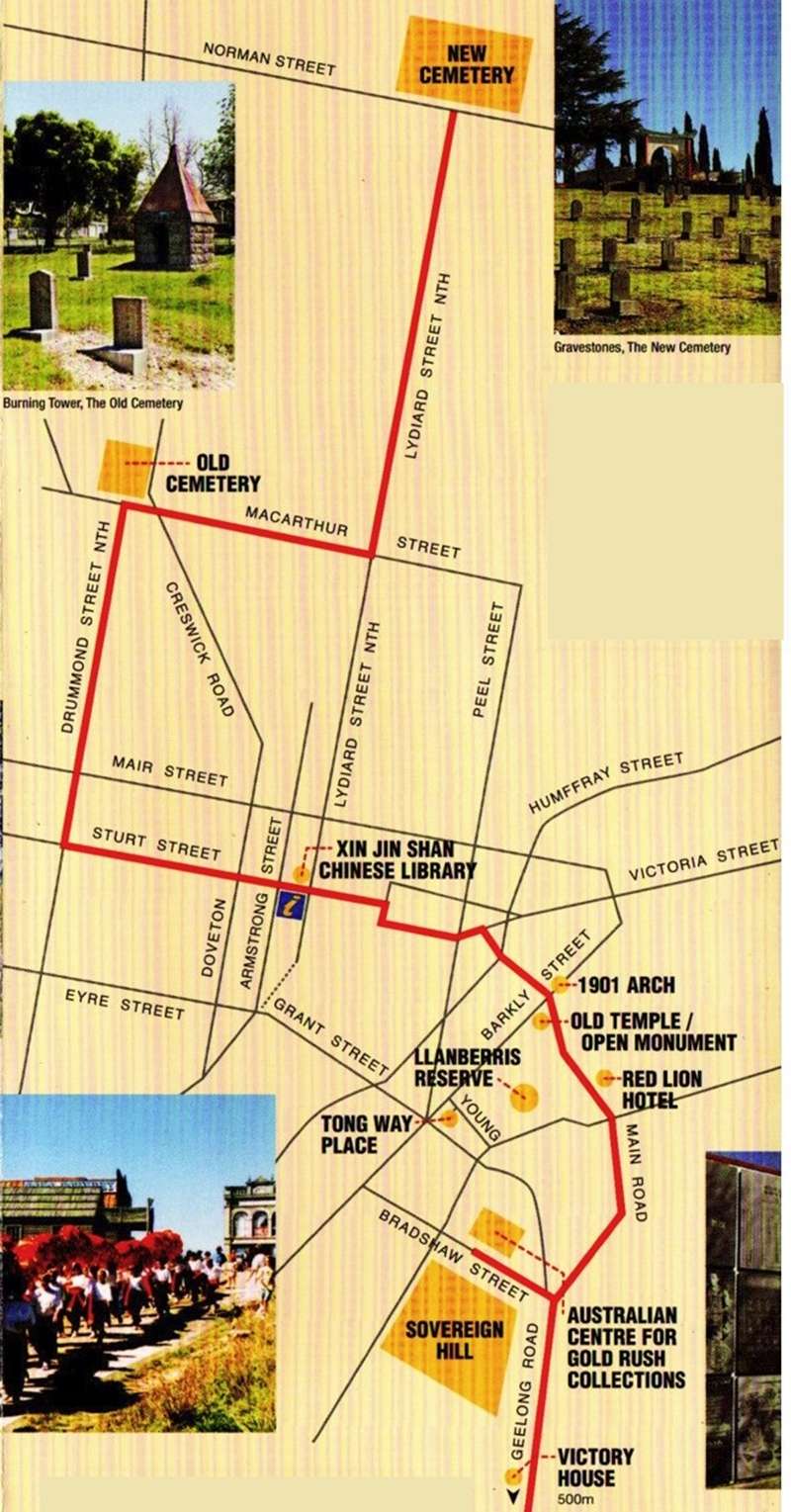
The Chinese Experience
The Cemeteries
• The Old Cemetery – Macarthur Street, Ballarat
• The New Cemetery – Norman Street, Ballarat North
With their ceremonial burial ovens and altars, steles and gravestones, the Chinese sections of the Old and New Cemeteries offer rich information on Chinese life, burial and religious customs. They also provide an indication of the size of the Chinese population in early Ballarat.
In Fading Links to China (1992), scholars Linda Brumley, Liu Bingqun and Zhao Xueru have gleaned from the gravestones and associated government and cemetery records detailed information on the many buried miners who did not make it back to their homeland.
One of the few gravestones inscribed in English is that of O Cheong who for nine years was the government interpreter in the colony. His grave is in the Old Cemetery.
In the New Cemetery, the Chinese graves have been restored and re-consecrated. A unique feature of this cemetery is the Gum Loong Friendship Garden. The garden, which is a memorial to those early miners, has been built following Feng Shui principles.
Sovereign Hill
Bradshaw Street, Golden Point
Sovereign Hill, an open air museum, recreates Ballarat’s first ten years following the discovery of Gold in 1851. In Sovereign Hill there is a Chinese Village. A fee is charged to visit Sovereign Hill.
Australian Centre for Gold Rush Collections
Bradshaw Street, Golden Point
Its collection of 150,000 objects has a significant component of Chinese artefacts from the gold rush period. From time to time there is an opportunity to take specialised tours to view the Chinese collections. A fee is charged for the tours.
Victory House
742 Geelong Road, Canadian
The house was constructed in 1906 for James Wong Chung, Manager of the You Hing mine (Woah Hawp Canton mine). The house remained in the Wong Chung family till 2008. It was recently purchased to preserve the house as an important addition to the history of the Chinese in Ballarat and establish the house as a Museum.
Xin Jin Shan Chinese Library
200 Sturt Street, Ballarat
The Library, New Gold Mountain Chinese Library, has the largest collection of its kind in the Southern Hemisphere. It currently holds 100,000 Chinese books. Open Wednesday to Sunday 10am to 5pm.
Red Lion Hotel
223 Main Road, Golden Point
The hotel was built and owned by the Mong family for more than sixty years from 1900.
The Chinese Arch
The Arch was built by Chinese residents as part of the decorations for the visit to Ballarat by the Duke and Duchess of Cornwall on 13th May 1901. Located near the entrance to the Ballarat East Town Hall Gardens on the corner of Main Road and Barkly Street, it was elaborately decorated and was nearly 18 metres high. It was dismantled after the event.
Through the arch can be seen the present day entrance to the Ballarat East Town Hall Gardens, fire station and the former library.
Site of the last Chinese Temple / Open Monument
Len T. Fraser Reserve, Corner Main Road and Barkly Street, Ballarat East
The last Chinese Temple occupied this site. It was demolished in 1962. The Open Monument was designed by John Young and completed in 2019. Etched onto the stone panels are personal accounts and images recognising the contributions of the Chinese community to Ballarat.
Tong Way Place
2 Tong Way Place, Golden Point
This is the site of the Chinese Presbyterian Mission Church and Manse erected in 1880. Reverend Tong Way with his wife Mary and family lived there between 1903 and 1949 until the Reverend Tong Way retired as the Superintendent Missionary responsible for the welfare of the Chinese population on the gold fields.
Gum Loong Gum Loong, the traditional Chinese fortune dragon, was made entirely in Ballarat by the school communities of Canadian Lead, Mount Blowhard and Sebastopol Primary Schools. He was awakened at the Chinese Village in Sovereign Hill on 11th March 1995. When not on parade, he lives at one of the schools who care for Gum Loong. Visiting Gum Loong and his family can be arranged by contacting the schools.
Location
1250 Doveton Street North, Invermay Park 3350 View Map


