Anglesea - Loveridge Lookout


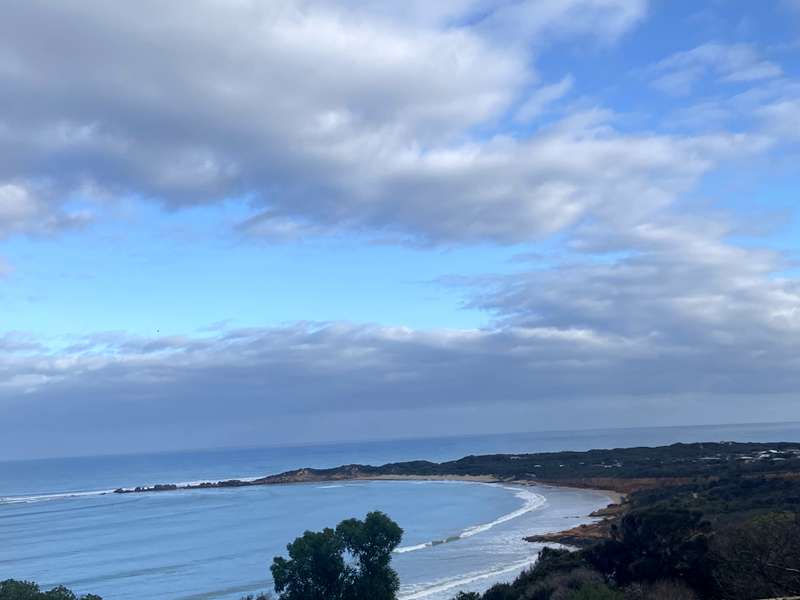
Loveridge Lookout offers sweeping panoramic views across Anglesea, the Anglesea River estuary, Point Roadknight and the Southern Ocean. Perched high above the town, the lookout provides a spectacular vantage point to appreciate the dramatic meeting of forest, river and coastline. The lookout is set back from the Great Ocean Road and the views are a bit obstructed and distant.
The lookout was established in 1938 by Bertha Loveridge as a memorial to her husband, James Loveridge. During World War II it became one of a network of coastal observation posts, where volunteer aircraft observers kept watch for enemy aircraft and ships. Today, heritage plaques and memorials at the site tell the story of these volunteers and the important role they played in Australia's wartime defence.
A short walk from the car park leads to the main viewing area, where visitors are rewarded with magnificent views over the coastline and township. The lookout is especially popular at sunrise and sunset, when the changing light transforms the cliffs, beaches and ocean. It is also an excellent place to watch seabirds soaring on coastal updrafts and, during winter and spring, to look for migrating whales offshore.
Loveridge Lookout is more than just a scenic stop. The lookout features attractive stonework, interpretive signs, a sheltered seating area and a colourful mosaic that celebrates the surrounding landscape.
Directions - Follow Harvey Street uphill from the Great Ocean Road to the lookout car park.
Anglesea Lookout Reserve Signage
GEOLOGY
To the north-east across the Anglesea River, the tall cliffs expose sedimentary rock of the Tertiary Age (less than 65 million years old). The sediments consist of a series of sandstones, mudstones and shales, intermixed with coal and basalt. These sediments were laid down under fresh water and estuarine conditions as the great southern land of Gondwana broke up and the continent and islands drifted north from Antarctica.
The shape of the coastline is formed by resistant units (sandstones and basalts) exposed in some places and softer units (mudstones and shales with minor marls) exposed in others. The sea erodes the softer units first. The presence of old fault lines also affects the coastline shape, and can be a major contributor to indents in the coastline especially where all the rocks exposed are resistant. The discharge of sediments from rivers into the ocean also plays a role in the formation of the coastline.
LANDSLIP
South east of Loveridge Lookout is Roadknight Bay (once called Princess Mary Bay). To the south west is a small red cliff, trending up towards the Great Ocean Road. This marks the edge of the major 1903 landslip which extends across a low valley to within a few metres of Loveridge Lookout. When the hillside collapsed early in the morning the tremendous roar woke people throughout the district.
At the time of the landslip, a local identity, Jonas Hollingworth, lived in a bark-hut at Point Roadknight. Rumour has it that he had quietly rowed out to the wreck of the ‘Inverlochy’ and ‘borrowed’ a case of whisky, and buried it. About 4 am the following morning he was awoken by the roar of the landslip which covered his newly acquired whisky!
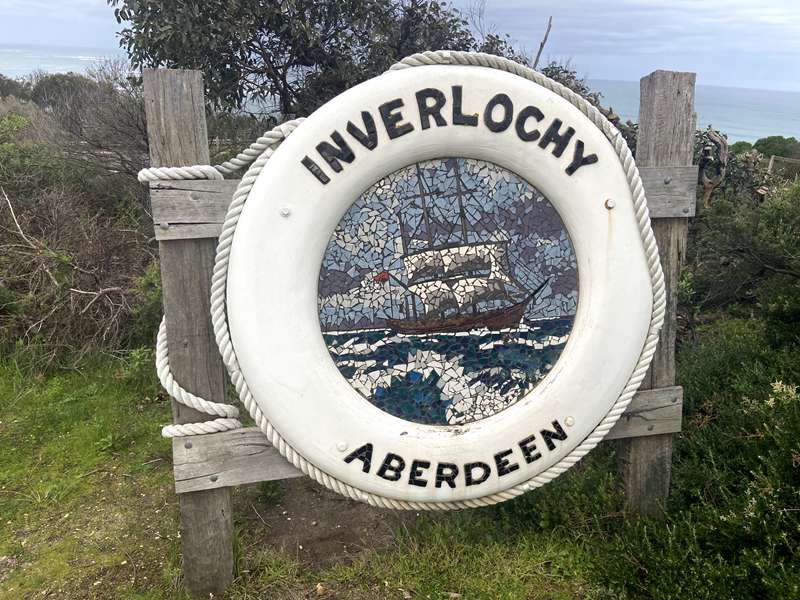
WRECK OF THE ‘INVERLOCHY’
On the 18 December 1902 the ‘Inverlochy’, a three masted 1471 ton barque, foundered on Ingoldsby Reef, about a kilometre east of the Anglesea River-mouth.
The ‘Inverlochy’ was sailing from Liverpool to Port Phillip, Launceston and Hobart with a general cargo and a crew of 30 and one passenger. No lives were lost.
Salvage operations retrieved some of the cargo from the ‘Inverlochy’ including a bicycle belonging to the passenger. Strong south-easterly winds in early February 1903 caused the vessel to break up, and large quantities of the cargo washed up onto the beaches.
The ship’s logbook and a lifebelt is on display in the museum of the Anglesea and District Historical Society.
GROUNDING OF THE ‘HEREFORD’
The ‘Hereford’ an iron clipper of 1524 tons grounded on a reef just off Point Addis on 12 January 1881 close to the shore. She went stern foremost onto a reef under water, and became firmly wedged. The ship was abandoned and the passengers numbering 12 cabin and 37 steerage were landed nearby by the ships life-boats.
Two steamers later helped recover cargo. It was not until February that the lightened ship was towed through the Heads into Hobson’s Bay for assessment.
LOVERIDGE LOOKOUT
Loveridge Lookout was built in 1938 as a memorial to James Loveridge by his widow Bertha Loveridge. The Lookout is located near the former Loveridge owned property ‘Anglecrest’.
This site was selected by Bertha Loveridge as it was James Loveridge’s favorite viewing location of Bass Strait.
Loveridge Lookout was designed by the prominent Ballarat architect H.L. Coburn in the interwar Modern Functionalist style and is the only surviving reinforced concrete structure of this construction type in Anglesea.
The original ‘Anglecrest’ was burnt down in the Ash Wednesday bushfires in February 1983.
WAR SERVICE 1939–1945
During the Second World War Loveridge Lookout was an observation post for the Volunteer Air Observers Corps. From 1942 until 1945 the post was continuously manned by a group of 56 local volunteers and played a critical role in the ground warning strategy of the Royal Australian Air Force.
Given the need for constant surveillance, a small room was built on the western or car park side of the Lookout. This small flat-roofed shelter was lit by a kerosene lamp and heated by a small pot-belly stove. As a security measure a temporary barbed wire fence encircled the Lookout.
By 1945 Anglesea had recorded 3000 aircraft movement reports. The type of aircraft seen included: Ansons, Oxfords, Kittyhawks, B25 Mitchell bombers, Spitfires, Beauforts, Liberator Bombers and Mustangs. These aircraft were either on submarine patrol or on navigation training exercises.
FLORA and FAUNA
The Anglesea Lookout Reserve is nationally important in maintaining indigenous flora and fauna biodiversity.
This small remnant of coastal heathland is extremely rich in plant species. Windswept low growing grasses, sedges, herbs and small shrubs are entwined, forming a blanket cover over the landscape. Some beautiful orchids are found beside the tracks and in the more open areas.
As season follows season, varying colours emerge as the different species come into flower.
The naturally sculptured tapestry of heathland provides habitat and food sources for numerous birds, small mammals, insects, reptiles and other animals that all have a special relationship with the heathland vegetation.
More than 100 orchid species are found in the Anglesea Heathlands representing half of Victoria’s orchid flora.
For more information contact ANGAIR, the Anglesea Aireys Inlet Society for the Protection of Flora and Fauna.
Photos:
Location
45 Harvey Street, Anglesea 3230 View Map


