Aboriginal Melbourne Walk (Central Melbourne)


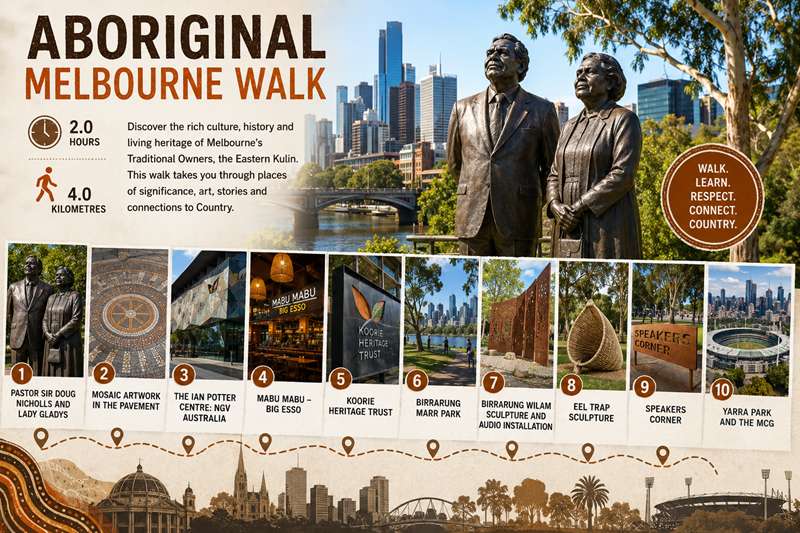
The Eastern Kulin is an alliance of 5 Traditional Owner groups: the Wurundjeri, Bunurong, Dja Dja Wurrung, Taungurung and Wadawurrung peoples. Eastern Kulin Country extends around Port Phillip and Western Port, up to the Great Dividing Range and through the Loddon and Goulburn River valleys. The groups are spiritually, culturally, politically and economically connected with a shared creator, Bunjil.
Find artifacts of Aboriginal history and culture like scarred trees, historical meeting places and monuments on this 4.0km (2 hour) walk.
Aboriginal Melbourne Walk Map
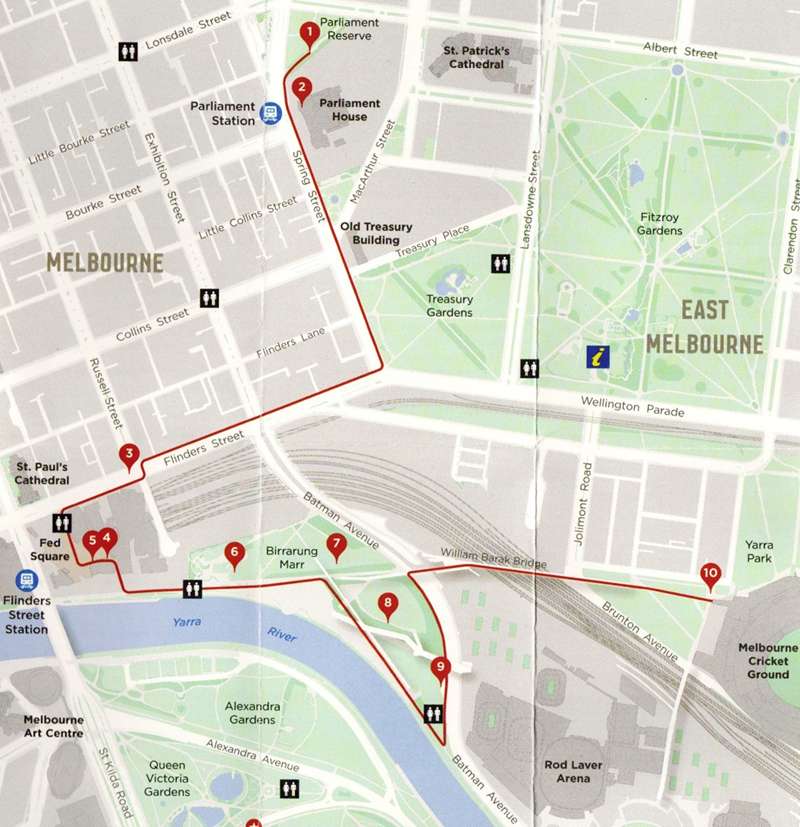
Start at Parliament Gardens where statues commemorate Aboriginal activists Pastor Sir Doug Nicholls and his wife Lady Gladys (1), who dedicated their lives to community service. Their great-granddaughter Ngarra Murray etched totems into the blue stone paving here signifying the emu - Bigarrumdja (Yorta Yorta) - and the Crow - Waa (Boon Wurrung/Woi Wurrung).
Continue towards Parliament House to discover a mosaic artwork in the pavement (2), an interpretation of William Barak’s painting ‘Ceremony’. It references this site as a former traditional ceremonial ground and meeting place.
Head to Fed Square to explore The Ian Potter Centre: NGV Australia (3), a showcase for Indigenous art from the NGV collection. Renowned artists include Emily Kame Kngwarreye and Rover Thomas, alongside contemporary works by Brook Andrew and Destiny Deacon.
Visit Mabu Mabu - Big Esso (4), a bar and kitchen bringing First Nations’ food to Fed Square by Torres Strait Islander chef, Normie Bero. Get comfy at communal tables and tune into ‘Island Radio’ highlighting blak performers. Drinks feature native ingredients and are supplied by Indigenous-owned and social impact businesses.
Next door is the Koorie Heritage Trust (5), a First Nations arts and cultural organisation with a program of events, exhibitions, tours and a shop for design pieces by Indigenous makers and creatives.
The steps near Transport Hotel lead to the river terrace and Birrarung Marr park (6). In the Woi Wurrung language of the Wurundjeri people, birrarung means ‘river of mists’ and ‘marr’ relates to the edge. It’s a place for community and celebrations.
Spend some time with the engaging Birrarung Wilam sculpture and audio installation (7), celebrating the cultural and spiritual connections between Aboriginal people and rivers.
Nearby is the Eel Trap sculpture (8), a reminder that eels were once an abundant food source close to this site. Made from weaving basket grass, eel traps were set near the shallow waterfalls that used to exist downstream, separating the freshwater of the river from the salty water of the bay.
Follow the river to Speakers Corner (9). Communities gathered here between the 1890s to the 1960s for regular forums and debates with renowned Aboriginal thinkers and activists like Bill Onus and Gary Foley. A sculpture and commemorative plaque marks the site.
Return through Birrarung Marr to the William Barak Bridge, connecting the city to Yarra Park and the MCG (10). A traditional gathering place for the Eastern Kulin, scarred - or culturally modified - trees can still be found in Yarra Park. Football games at the MCG are a tangible connection for the Eastern Kulin to this area. They played marngrook here, an early version of football, elements of which still feature in Australian Rules Football today.
Additional Places
BONUS Bunjilaka (Melbourne Museum)
Located at Melbourne Museum, Bunjilaka celebrates thousands of years of continuous culture through multimedia experiences and artworks, alongside garden trail and Forest gallery of indigenous plants and wildlife. The First Peoples permanent exhibition tells the story of Aboriginal Victoria from the time of Creation to today.
BONUS Standing by Tunnerminnerwait and Maulboyheener (Gallows Hill)
A commemorative sculpture by Brook Andrew (Wiradjuri) and Trent Walter, this memorial to the frontier wars reflects on Aboriginal men, Tunnerminnerwait and Maulboyheener, convicted of the murders of two whale-hunters, and executed by public hanging in 1842.
Kings Domain Resting Place
On 22 November 1985 remains of 38 Victorian Aboriginal people were repatriated by the Museum of Victoria and taken for reburial at King’s Domain. The site was chosen in the absence of being able to identify their origins and is marked by a granite boulder with an inscribed memorial plaque.
BONUS Tromgin Billabong (now site of ornamental lake) Royal Botanic Gardens
Tromgin Billabong, once part of an extensive integrated river and billabong system, survives as part of the ornamental lake in the Botanic Gardens. A traditional fishing spot, eels were a plentiful food source for Eastern Kulin people.
To further explore places of Aboriginal significance within the city visit aboriginal-map.melbourne.vic.gov.au.
Location
489-531 Albert Street, Melbourne 3000 View Map


