Maroondah Reservoir Park (Healesville)



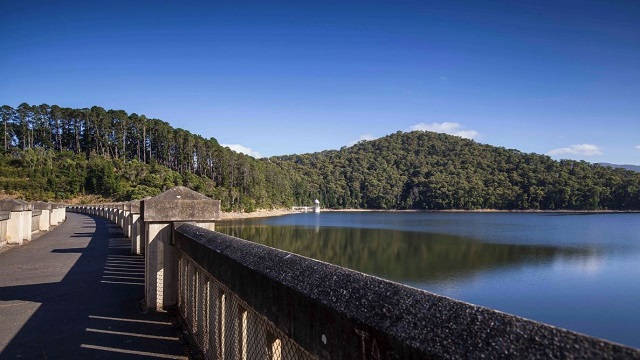
Maroondah Reservoir Park offers a wonderful variety of experiences, from colourful gardens to long and short walks, exotic and native trees, spectacular scenery and an abundance of wildlife. The scenic attraction of the reservoir and European-style gardens have made it one of the most popular parks in Victoria.
-embed08.jpg)
Things to Do
- Follow the 3 km track through magnificent native bushland from Maroondah to Donnellys Weir Park and watch out for echidnas and Swamp Wallabies.
- Photograph the historic Rose Stairway which is at its best in Autumn. Enjoy azaleas and rhododendrons in full bloom in spring.
- During the wetter months experience the awesome force of the water tumbling over the spillway.
-embed09.jpg)
Facilities
- Picnic tables, BBQs, rotundas, car parks, toilets, walking trails and a lookout is provided in the park.
Heritage
Maroondah Dam was completed in 1927 and the area below the wall landscaped in the early English tradition, creating a different character from that of most of Melbourne's reservoir parks which have concentrated on native trees and plants. Later development saw picnic areas developed with the native bush and the two forms are at once harmonious and interesting. The historic valve house and classical temple-like structure of the outlet tower reinforce the old world element.
Walks around the Park

Explore the cultural heritage of the park by selecting one of the tracks which passes through the formal gardens. Make sure you include the Rose Steps in your route.
Lookout Track (crosses dam wall)
- 1 km, 30 minutes, moderate
-embed07.jpg)
This track starts from the information shelter located north of the main carpark area. You can explore the attractions below the dam wall then climb the 'Rose Stairway' (for those who cannot climb steps there is a bitumen walking track, at the eastern end of the carpark, that also leads to the top of the wall).
At the top of the stairway the track to the left leads across the dam wall to the lookout for spectacular views.
Maroondah Forest Track
- 800m, 15 minutes, moderate
-embed06.jpg)
This track connects the Lookout to Henderson's Picnic Area via a pleasant forest walk. Not recommended for wheelchairs and strollers.
Scenic Views Track
- 1.3 km, 30 minutes, easy
This scenic walk starts at the top carpark. Winding through grassed areas with large exotic trees and spectacular views of the surrounding mountains the track eventually reaches the top of the dam wall.
Henderson's Hill Track
- 1.4km, 40 minutes, moderate
This track leaves Henderson's Picnic Area at the footbridge over the Watts River. It climbs to the top of Henderson's Hill and back down to the access road, which goes from Maroondah to Donnellys Weir. A walk to Hendersons Hill is more challenging. It incorporates some steep inclines and passes through a variety of forest types. Not recommended for wheelchairs and strollers.
Walk to Donnellys Weir Picnic Area
-5.6km return
The walk to Donnellys Weir Picnic Area largely follows management tracks to Donnellys Weir. Part of the walk runs along the historic Maroondah Aqueduct. Not recommended for wheelchairs and strollers.
Fauna
Animals and birds which may be seen include wombats, wallabies, echidnas, lyrebirds, Bronzewings, Cockatoos, Galahs, Sacred Ibis, King Parrots, Crimson Rosellas, and, in the evenings, Brushtail and Ringtail Possums, Sugar and Yellow-bellied Gliders and Tawny Frogmouths.
Vegetation
Bush tracks lead through stands of eucalypts and dense undergrowth of native shrubs and grasses. Azaleas and rhododendrons, planted in gardens lining the main entrance road provide a colourful show in Spring.
Looking After the Park
- Entry to catchment area prohibited.
- No camping or fishing.
- Please take your rubbish with you.
How to Get There
The park is located around 3 km from Healesville in the Upper Yarra valley and approximately 70 km east of Melbourne along the Maroondah Highway.
Opening Hours:
8am to 8pm - Early October to Early April (Start of Daylight Savings Time to End of Daylight Savings Time)
8am to 6pm - Early April (End of Daylight Savings Time) to end of April
8am to 5pm - May to August
8am to 6pm - September to Early October (Start of Daylight Savings Time)
These times apply to Maroondah Reservoir Park, Badger Weir and Donnellys Weir.
These parks and visitor sites are protected for water security purposes by automatic gates. The gates close at the above posted times, but they do allow for visitors to leave the park for 30 minutes after these times. From 30 minutes after the posted closing time however the after hours exit turns off and exit from the park is no longer possible. Parks Victoria is obliged to do this to help strengthen water resource security.
If a visitor mistakenly gets caught behind the automatic gates after the park closing time, upon exit please drive to within two metres of the gate to activate the late exit trigger. If the gate does not open as the vehicle is leaving too late, please call Parks Victoria on 13 19 63 to ask them to assist. A late exit fee may apply.
Access for Dogs:
Dogs must be on a lead and are not allowed north of the Watts River, including on the dam wall.
Review:
Maroondah Reservoir Park is one of the best reservoirs near Melbourne to visit.
There is plenty to do here - there is access to the top of the dam wall, access to the base of the dam wall, a series of steps up to the dam flanked by rose beds, plenty of picnic facilities (rotundas with tables, barbecues, picnic tables, water taps and toilets), lookout point over the dam and various walks (3.8km one-way to Donellys Weir, Maroondah Forest Walk). There is signage to a playground but that looks more like a discarded commando course rather than a playground and should be avoided.
The main picnic area with a rotunda and lots of unshaded picnic tables is Henderson's Picnic Area near the main carpark.
From the main carpark area a gravel road leads to Watts River Rotunda on the west side where there are tables and BBQs. A number of walking tracks start from here:
- Dam Wall via Maroondah Forest Walk 850m
- Summit of Henderson's Hill 850m
- Maroondah Reservoir Lookout 900m - has views of the wall and reservoir
- Donnelleys Weir Picnic Area 3.4km
History of the Maroondah Reservoir Park
The construction of the Maroondah Dam brought considerable number of people and their wages to Healesville. The building of the dam commenced in 1920. For several years before this date workers were engaged in clearing harvestable timber from the area to be inundated.
Following completion of the Maroondah Dam in 1927, a small area of the current park was developed using the dam wall, spillway and valve houses as major features.
Following landscaping trends of the time, the earliest gardens were planned using traditional English designs. This influence is still evident in the green lawns, flower beds and plantings of deciduous trees and conifers in the area immediately below the dam wall.
The north facing slope which lies between Maroondah Highway and the dam wall was developed as an exotic woodland in the years immediately following the completion of the dam. A wide variety of species were planted including Bunya Bunya Pine, Cork Oak, California Redwood and Norway Spruce.
During the mid to late 1940s, considerable beautification of the park was undertaken. Much of the stonework which is seen in the park today was laid during this time, including the upper section of the rose steps. The lower section was completed at an earlier date.
During the Second World War, the park was closed to the public for security reasons. The wall and reserve were patrolled to guard against enemy attack or sabotage. The loss of Maroondah Reservoir (remembering that many of our larger water storages had not yet been built) would have denied Melbourne a significant proportion of its water supply and seriously hampered the city's war time manufacturing effort.
The early 1950s saw a spate of landscaping activity occur. The sundial which is located immediately below the dam wall was built in late 1952 by Bruce Duscher - caretaker of the park, employed by the Melbourne & Metropolitan Board of Works. The number eight was left off the dial because the sun's rays are obscured at this time of the morning and evening.
Another piece of Bruce Duscher's work is the garden bed featuring the Australian Coat of Arms. Built in the the mid 1950s it used the design found on a sixpenny coin as inspiration. The bed and coat of arms were removed in 1982.
Maroondah Reservoir Park was smaller than it is now. The western boundary of the park used to be where the main carpark and formal gardens currently meet.
The area to the west of this boundary was owned by the Henderson family. They ran a camping ground and kiosk.
The Hendersons' kiosk occupied the site of the current kiosk, and the campground was located where the main carpark is now.
In 1951, the Melbourne & Metropolitan Board of Works was offered the opportunity to purchase a parcel of land adjoining the western boundary of Maroondah Reservoir Park. It was not until 1972 that the park was extended to include the Henderson property. Retaining much of the remnant cover of Manna Gums and Swamp G, the area became known as Hendersons Picnic.
Fauna of the Park
Bird life in the park is abundant. Australian White Ibises, Kookaburra, Maned Ducks, Sulphur-crested Cockatoos, King Parrots, Common Bronzewings, Noisy Miners, and Crimson Rosellas can be seen regularly. The juvenile Crimson Rosella's plumage is predominantly green, with some red and blue blotches, contrasting strongly with the striking red and blue colours of the adult bird.
From time to time visitors will be rewarded by the sight of Yellow-tailed Black Cockatoos which pass through the park. Their slow deliberate flight is in marked contrast to the more energetic and acrobatic motion displayed by their noisy relative, the Sulphur-crested Cockatoo.
Swamp Wallabies, Echidnas, Blue-tongued Lizards and Wombats may also be found by keen observers.
In the evenings, Brushtail and Ringtail Possums and Sugar Gliders become active as they leave their treetop homes. The Manna Gum (eucalyptus viminalis) woodland at Hendersons Picnic Area provides a significant number of habitat trees for these arboreal (tree dwelling) marsupials. Naturally occurring tree hollows are augmented by nesting boxes provided by park staff.
Flora of the Park
The English style gardens that surround the dam wall are in vivid contrast to the surrounding native eucalypt forest.
Based on traditional garden design of its time, the early landscape development at Maroondah Reservoir Park featured almost exclusive use of exotic (introduced) trees, shrubs and annuals.
The extensive array of exotic trees, both angiosperms and gymnosperms alike, is one of the major attractions of the park. The largest specimens are the stately Big Tree or Giant Sequoia (Sequoiadendron giganteum), and the giant California Redwood (Seqoia sempevirens) which is found below the dam wall. Not only is the California Redwood the tallest species of tree in the world, attaining heights of up to 120 metres, it is also the longest lived with some individuals reaching an age of 4000 years.
Aboriginal History of Maroondah Reservoir Park
Prior to European settlement, the land which now takes in the Maroondah catchment and Maroondah Reservoir Park was inhabited by the Wurundjeri-Wallam clan. Their territory included land along the Yarra River, from its source at Mt. Baw Baw to its junction with the Maribyrnong River.
The Wurundjeri were not an isolated group. Together with four other clans they formed the Woi Wurrung tribe. The Woi Wurrung, along with the Watha Wurrung, Djadja Wurrung, Daung Wurrung and Boon Wurrung tribes formed a larger group known as the Kulin Nation. The people of the Kulin clans shared a similar language, with small differences based on tribal and clan associations. The people of adjacent nations spoke completely different sets of languages. These differences in language formed the basis of the tribal and clan boundaries that we see today.
The Aboriginal name for the lower reaches of the Watts River is Broongkalk, meaning ''rotten log". European settlers renamed the river "Watts'` after a stockman who drowned whilst attempting to cross on horseback during a flood.
Photos:
Location
505 Maroondah Highway, Healesville 3777 View Map
Web Links
→ Maroondah Reservoir Park
→ Maroondah Reservoir Park - Park Notes (PDF)
→ The Best Family Activities in the Yarra Valley


