Kalorama Park (Kalorama)


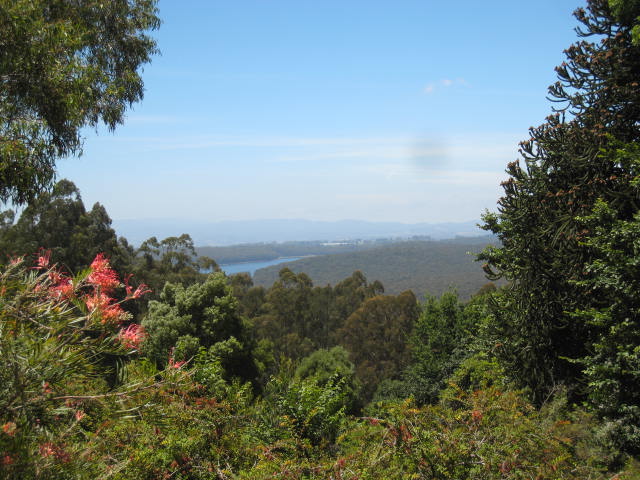
Boasting spectacular views over Silvan Reservoir and the south-eastern face of the Dandenong Ranges, Kalorama Park is perfect for picnics, barbecues or simply relaxing whilst enjoying the magnificent surrounds. Kalorama Park is bordered by lush temperate forest on the eastern side and Dandenong Ranges National Park to the north and south - both of which provide numerous walking opportunities.
-embed01.jpg)
Things to Do
- Enjoy a relaxing picnic in the area below the lower carpark which is surrounded by garden beds with elm trees, silver birch, pine trees and pin oaks, along with Australian native plants and ferns.
- An expansive grassy area near the upper carpark is an ideal setting to spread out the picnic blanket and enjoy lunch. The views over the south-eastern face of the Ranges are spectacular from the upper carpark. A number of large eucalypt trees and tree ferns in the area offer ample shade to escape the summer heat.
- Kalorama Lookout is located on the Mount Dandenong Tourist Road at the Five Ways intersection. The lookout provides one of the finest vantage points to view the Dandenong Ranges, surrounding foothills and Yarra Ranges in the distance.
- A number of short walking tracks commence from each of the three carparks. These tracks are ideal for a short stroll before or after your barbecue lunch. The tracks pass through native forest, historical fruit orchards and exotic plantings.
- Other bushwalking opportunities exist within the Doongalla section of the Dandenong Ranges National Park, located on Ridge Road opposite the Kalorama Lookout carpark.
- There are also a number of walking tracks in the Olinda section of the national park, located east of the lower carpark, down Barbers Road.
Facilities
- The picnic area below the lower carpark has two gas barbecues under the picnic shelter, making it the perfect place for a family or group get together.
- There are two toilet blocks located within the park. One is located just below the Lookout Carpark while the other is just above the main picnic area.
- A drinking fountain and water tap are located within the main picnic area near the picnic shelter.
Heritage
The first Europeans to settle in the Kalorama valley area were Isaac Jeeves, Mathew Child and Jabez Richardson, with their families. The three families built their homes along what was then called 'Running Creek', now known as Olinda Creek. In 1870, Jeeves sold part of his allotment to Thomas Hand, who was a surveyor with the Upper Yarra Road Board. This allowed Jeeves to purchase land in the 'Gap' which was named Jeeves Saddle, and is now known as 'Five Ways'.
The Jeeves family, through son Ellis and grandsons Hubert and Walter, retained ownership of part of the original title of land for nearly 100 years. During this time the entire open section of the park was cleared of its natural vegetation, for logging and grazing purposes. In 1963, the State Government purchased 13 hectares from the Jeeves family, followed by another nine hectares of adjoining land later on.
The 'Save the Dandenong's League' was instrumental in the purchase of this land to conserve it from further development and raised half the cost through subscriptions and a public appeal.
Relics that still remain are the old farm shed, thought to be built by the Jeeves family in the 1940s, and the barbecue pavilion built by the Forest Commission to commemorate the site where Ellis Jeeves built a house.
Fauna
The forest supports a diversity of wildlife. Stay alert and you may be surprised at what you see. Mistletoe Birds, Yellow Robins, Eastern Whipbirds, Crimson Rosellas and Golden and Rufous Whistlers are just some of the more commonly seen birds in the park.
Nocturnal animals include Common Ringtail and Brushtail Possums, Sugar Gliders, Black Wallabies, wombats and echidnas.
Vegetation
Remnant Mountain Ash forest covers the eastern section of the park. This type of forest was prominent throughout the Dandenong Ranges before European settlement and the resulting widespread clearing.
Mountain Ash trees can reach heights of up to 150 metres and may live for 400 years - due to a number of fires the oldest are around 150 years in age.
There are three distinct layers of vegetation below the canopy of Mountain Ash trees. Ferns and grass species make up the ground cover, with the mid-storey comprising Hazel Pomaderris, Blanket Leaf, Soft and Rough Tree Ferns, Musk Daisy Bush and Blackwood Wattles.
Kalorama Park features around 80 orchard trees planted by the Jeeves family over 100 years ago. The orchard area consists of plum, apple, peach and walnut trees that are scattered through open cleared grasslands.
Other historically significant trees of Kalorama Park include two Elm trees above the five ways carpark, which were planted by the Jeeves family to mark the gateway to the original property.
Remnants of the original formal garden beds still remain today and have been restored with recent plantings of azaleas, rhododendrons, native ferns and grasses.
Opening Hours:
Open all hours
Cost:
Free
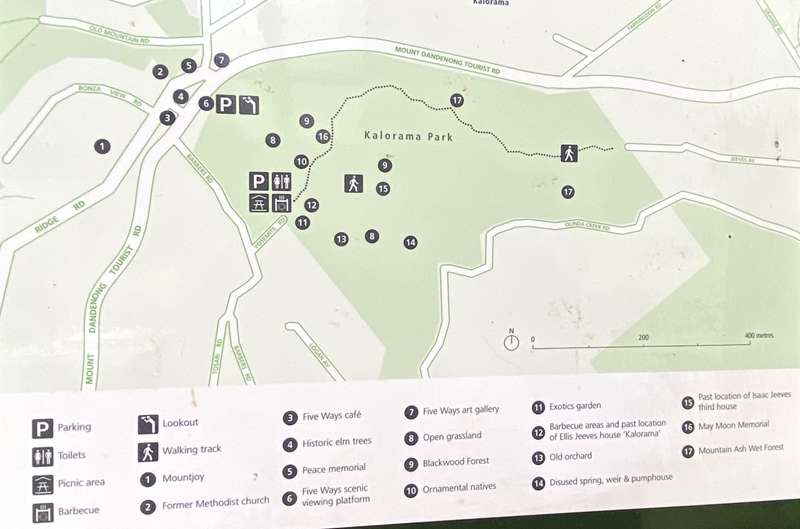
Kalorama Park Map
Review:
There are some lovely short walks (less than an hour return) which passes through a Mountain ash forest and cool, shaded fern gullies. We took the path to Jeeves Avenue and returned back the same way. The path is steep in sections and could be very slippery when it is wet. There are picnic facilities but the number of tables is quite limited. At the top of the hill is a lookout with lovely views and a cafe.
Information Signage
Welcome to Kalorama Park
-embed02.jpg)
Welcome to this park of spectacular views and beautiful natural features. It is a perfect place for picnics, barbecues or simply relaxing and reflecting in magnificent surroundings. Kalorama Park covers 22 hectares (54 acres) and provides a number of interesting landscapes including old temperate rainforest, large open grassy areas and ornamental plants.
This area has an important local history and a significant role as part of the Dandenong Ranges National Park. First recognised by the Wurundjeri people as a very special area for its amazing resources and natural features, then by European settlers as a beautiful and bountiful environment.
Later protected and managed as parklands, these landscapes provide locals and visitors with enormous benefits and opportunities; outdoor recreation is directly linked to improving mental and physical health. The forest and open spaces around you also provide a habitat for native plants and animals, protecting them for future generations.
Things to See & Do
Looking out from Kalorama on a clear day you can see Silvan Reservoir and the distant ranges. Some days cloud wraps around the remnant Mountain Ash Forest that covers the eastern section of the park. This type of forest was prominent throughout the Dandenong Ranges before European settlement. Mountain Ash trees can reach up to 100 metres high and 400 years old, however the ones in Kalorama Park are relatively young at less than 200 years old, due to a number of bushfires that have occurred here.
There are different layers of vegetation below the canopy of Mountain Ash trees. The forest supports a great diversity of wildlife, stay alert and you may be surprised at what you see. Mistletoe Birds, Yellow Robins, Eastern Whipbirds, Crimson Rosellas and Golden Whistlers are some of the local residents. There are also many nocturnal animals including Ringtail Possums, Sugar Gliders, Black Wallabies, Wombats and Echidnas.
A number of short walks commence from the Kalorama carparks. These tracks are ideal for a short stroll before or after your picnic lunch. The May Moon Track passes through native forest, historical fruit orchards and exotic plantings. If you would like a longer walk or a bigger challenge, check out the maps and information on the Parks Victoria website for the Dandenong Ranges National Park. If you have your car take a drive down to nearby Olinda Falls, or across the mountain to the beautiful Rhododendron Gardens.
The Birth of Kalorama Park
After bushfires in 1939, parts of local land were sold off to extend the Tourist Road, as reserve land for the Silvan Dam and as house building blocks. In 1963 the "Save the Dandenongs League" raised £5,000 to buy 20 acres. The government bought another 20 acres and Kalorama Park was opened in April 1973. Within the park there are memorials to founding members from the league.
Challenging Times
In the 1990s the removal of an old toilet block, playground and pond were met with resistance from the community. Then in 1998 newspapers reported on a proposal by a businessman to build an overhead cable-car between Silvan Reservoir, across Kalorama Park, up to the Five Ways lookout and on to the Observatory Reserve at Mount Dandenong. Significant local community concern prevented the development after persuading the government of the special environmental and social values of the area.
Being a Friend of the Park
The local action group went on to form a voluntary community group called the Friends of Kalorama Park. In collaboration with Parks Victoria, the group has undertaken many projects including removing weeds and fallen trees, planting native shrubs, establishing a garden, restoring stone walls, building the gazebo barbecue area and disabled access paths.
Heritage Story of Kalorama – European Settlement
Forging a Way Through
In the early 1850s Botanist Baron von Mueller, director of the Melbourne Botanical Gardens, explored the Dandenongs and wrote glowing reports of the rich soil and unexploited forest. He suggested to Matthew Child that he attempt to settle the land on the eastern slopes of the ranges.
In 1855 Matthew Child, Jabez Richardson and Isaac Jeeves hacked a 7 mile track through the densely timbered forest to the source of "Running Creek", now known as Olinda Creek. The "Dray Track" passed through what is now Silvan, Mt Evelyn and Lilydale.
The men staked their claims using Miner's Rights and for many years the three families sold their produce at the Lilydale markets.
Links to the Past
The name "Kalorama" was coined from the Greek words "kalos" meaning beautiful and "horama" meaning a view. It was suggested by a visitor to the area, Reverend Henschelwood, as the name for the first house constructed on this site.
This fireplace stands on the site of the original chimney of the house built by Ellis Jeeves. The picnic shelter reflects the form of a barn which once stood nearby.
A small rock wall across the creek is probably the remnants of an old weir that fed water to the first house Isaac Jeeves built in 1871. The only remaining building on the current site of the park is a farm shed thought to have been built in the 1940s.
Putting Down Roots
The open grassland areas of Kalorama Park reflect the past logging and clearing for agriculture. Isaac Jeeves' grandson Walter and daughter Esme planted an Arboretum of New South Wales Christmas Bushes and an orchard of plums, apples and peaches. The daffodils still found growing wild in the meadows below are a lasting legacy of Walter. Many other non-indigenous trees planted by the Jeeves family are among the oldest in the Dandenongs.
Of note in the garden here is a rare Monkey Puzzle tree and some early varieties of Rhododendrons. Walnut trees and other fruit and nut trees can be seen in the park. Walter Jeeves was also instrumental in the establishment of the Mount Dandenong Arboretum on Ridge Road.
Heritage Story of Kalorama - Five Ways Lookout Area
Catering & Communicating
In 1904 the "Beulah" tea garden, begun by Eliza Hand, famously offered large glasses of cooling ginger beer. The following year she added a dwelling to the shop in which she lived with her daughter Florence. In 1909 this building became the Mount Dandenong North Post Office, with Florence as the Post Mistress. The Methodist Church opposite was built in 1909 for the community, on land donated by Ellis Jeeves.
In 1912 when the telephone came to the area, a manually operated telephone exchange was added to the post office.
Subscribers to the exchange had call names: E. Jeeves - "Mountjoy", K. Robertson - "Cherry Farm", I. Pemberthy - "Kia Ora" and I. Jeeves - "Shiloah".
Before the connection of electricity, blocks of ice were hauled up from Croydon under potato sacks, but once refrigeration became possible, ice cream became a real treat on the mountain.
The other large building still at Five Ways was the site of the original general store. Later it became a bank, famous for an armed robbery in the 1960s. When the bank closed it became a gallery, with the safe still in situ.
Lest We Forget
The Peace Memorial at Five Ways was constructed "In Memory of Peace 1919" and commemorates the locals lost during the First World War. During the construction of the Mount Dandenong Tourist Road a number of large boulders were uncovered; a team of seven horses hauled the rock to form part of the memorial.
Heritage Story of Kalorama – The Jeeves Family
Starting Out
After arriving from Tasmania and claiming his land in 1852, Isaac Jeeves built his first two homes down near the Olinda Creek. The area around his home was a glorious garden of tree ferns; it had been described as the finest gully anywhere near Melbourne.
Isaac initially lived in a camp on the creek, working as a miner. The forest around and above them was full of large quantities of special timbers; Musk, Sassafras, Banksia and Blackwood. In the new homes that he built for his family, he favoured Blackwood, as it grew in abundance on his land.
Moving Up in the World
Isaac's first substantial home was occupied in 1858. His new dwelling was a five roomed house made entirely of Blackwood, with a crosscut tree fern floor.
He sold the first two houses, along with 120 acres of his original 160 acres, and moved to his third house, which he built on the flat section of the Kalorama Park near (the two old Walnut trees). He moved to this location to be closer to The Gap (now Five Ways) which had become the main entrance to the district.
Accommodating Visitors
In the late 1800s Ellis Jeeves became the owner of the land which is now Kalorama Park. In 1886 he built a house for his family on the site that is now the location of the barbecue area. As the Dandenongs had become a popular tourist destination for visitors from Melbourne, in the 1890s he enlarged the house to become Kalorama Guest House. The two elm trees on either side of the bus shelter at Five Ways originally provided an entrance to this house.
Eliza Hand, mother-in-law of Ellis Jeeves, opened the 'Beulah' tea gardens at Five Ways in 1904. In the same year the Old Coach Road was constructed from Croydon station to The Gap, and in 1907 Ellis bought the coachline with its mail contract.
In 1908 Ellis Jeeves moved his family to "Mountjoy", a substantial guest house on the ridge which had good stabling for his horses and a level yard for his coaches. His son Walter bought Kalorama House and the lower section of the farm. His other son Hubert bought the top section of the farm.
After the Tourist Road was built in the 1920s, the coach service was motorised and there was a garage and petrol station built on what is now the Five Ways lookout carpark. Walter's wife Dorothy was the last of the Jeeves family to live at Kalorama House, and died in 1982.
Photos:
Location
6 Yosemite Road, Kalorama 3766 View Map
Web Links
→ Dandenong Ranges National Park (Parks Victoria)
→ The Best Family Activities in the Dandenong Ranges


