Lal Lal Reservoir


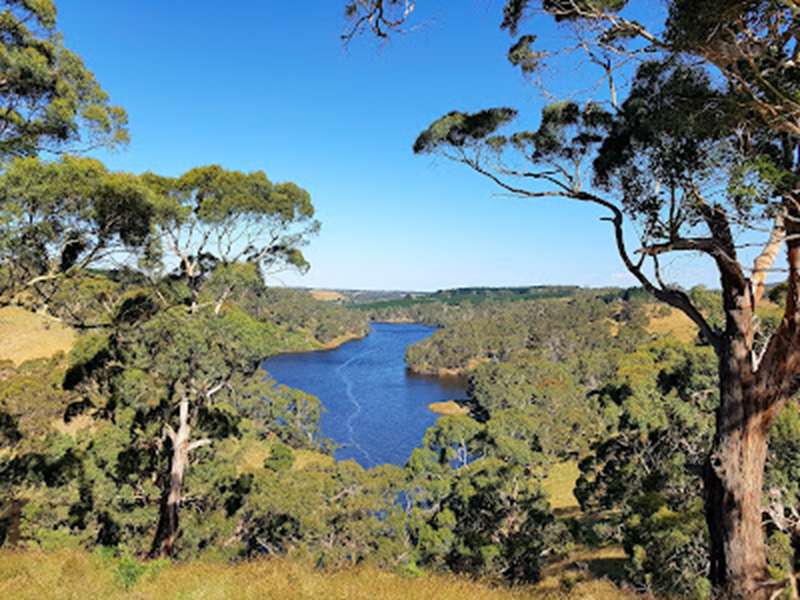
Lal Lal Reservoir / Bungal Dam has a picnic area with pit fire BBQs (BYO wood and fire starting materials). There is a viewing area and information board on the history of the building of the dam, surrounding area and indigenous culture.
Bungal Dam forms Lal Lal Reservoir for the supply of water to Ballarat and Geelong and was officially opened on 24th November 1972.
Naming the Dam
The site of Bungal Dam is about six kilometres south of Mt Egerton between the homestead area of the original Bungal Run and the Lal Lal Forest Reserve. The name Bungal (pronounced Bun-gawl) is an aboriginal word thought to mean "each" or "equal" divisions of". The Reservoir name is taken from the adjoining Parish of Lal Lal.
Catchment
The catchment of the Lal Lal Reservoir coven some 260 square kilometres within the Shire of Moorabool (formerly parts of the Shires of Buninyong, Bungaree and Ballan), almost the whole of which is privately owned. Approximately half of the catchment area is used for grazing and the remainder for mixed farming. It also contains five small townships which include some industry.
How the water is conveyed to Ballarat and Geelong
The Lal Lal Reservoir is well below the level of areas supplied in Ballarat, therefore water is conveyed via the pumping station on the South-Eastern abutment of Bungal Darn, between the embankment and the spillway.
Some 21 kilometres of pipeline was installed to a 29.5 megalitre pipe-head service basin at Warrenheip. The pumping station contains three pumpsets, two pumps being 22.8 megalitres per day capacity and one pump with a capacity of 30.2 megalitres per day, with provision for two more pumps.
The rising main diameter is 600mm as far as Navigators and 525mm from there to Warrenheip. The maximum static lift is I 60m, while the designed operational pumping head is 244m. A branch main at Navigators supplies water to tanks at Recreational Road, Mt Helen, and Green Hill.
Supplies for Geelong are released down the West Moorabool River to She Oaks, some 20 kilometres below the Dam, where Barwon Water has a diversion weir and pumping station.
Indigenous History
Aboriginal people (Koories) lived in the vicinity of Bungal Dam for tens of thousands of years before the arrival of Europeans. They lived in small clans of several families, the Tooloora Balug group of the Wathaurung tribe being the inhabitants of this area. They lived well on seasonally abundant plant foods,
fish and wild life.
A permanent water supply and the Koorie concept of belonging to the land were the key elements for the successful co-existence of the people with the flora, fauna and environment.
White pipe clay found in the area was an important commodity being used for body decoration in celebrations and ceremonies and as an article for trading for other clans and tribes for raw materials and manufactured objects not produced in their own territory.
The Wathaurung tribe occupied from south of Geelong towards Cape Otway, northwest to Beaufort and east to Queenscliff.
European settlement was disastrous for Koories, firstly by the introduction of foreign diseases which proved fatal, then displacement from traditional hunting areas which resulted in violent clashes and a number of massacres.
Lal Lal Falls just to the east of here is a culturally significant site for Koorie people as it was created by Bunjil to relieve the monotony of the then flat barren landscape. Bunjil was considered by most Victorian tribes to be the creator or all father, during the creation time. (He thought so much of these falls that he decided to make them his earthly home for a while).
He moved across Victoria creating the landscape as he travelled including Ballarat (resting place), the Black Range (Burunj) near Stawell and Halls Gap (Pudja Budja). Bunjil's cave in the Black Range was his shelter where a painting of himself and two dingo dogs are displayed. Bunjil can still be seen at night as the brightest star in the sky.
Map of Area

Near the reservoir is an historic Blast Furnace (believed to be the only one of its type and age (1890's) in place in the world). It was used to smelt iron ore from the local nearby quarry and was then made into ingots and transported to various cities and towns to be made into functional and decorative items. The gates and fence of St. Patrick's Cathedral in Ballarat are made out of iron ore from this Lal Lal area.
There is a short walk with informational plaques describing the workings of the quarry and the Blast Furnace.
Photos:
Location
Ironmine Road, Lal Lal 3352 View Map


