Beech Forest - Californian Redwoods


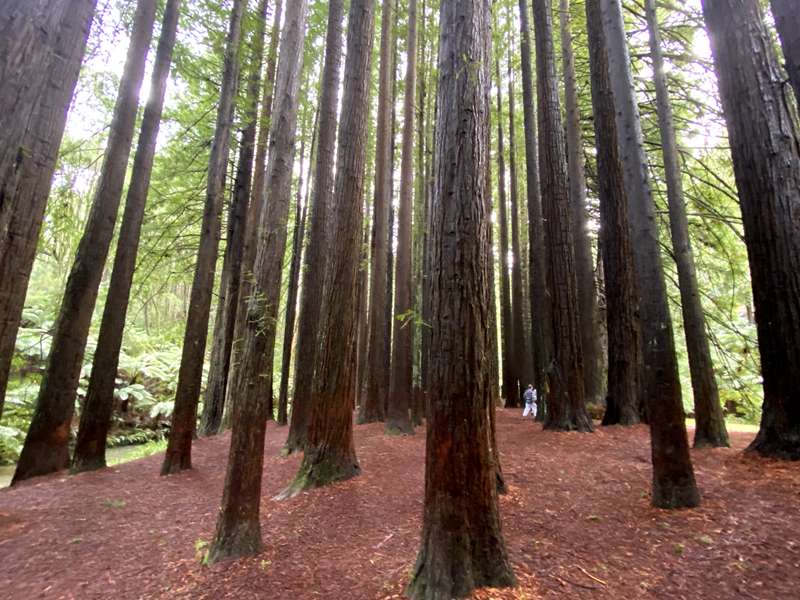
Californian redwoods are noted for their extreme height and are indigenous to coastal California and the southwestern corner of Oregon in the United States.
These redwoods were planted in the Great Otway National Park in the 1930s as part of a softwood logging experiment and the great growing conditions in this area has meant that the trees have already grown to a height of over 60 metres.

Located near the intersection of Binns Road and Horse Paddock Road, Beech Forest. Watch out for logging trucks on the neighbouring roads.
The picnic area has two unshaded tables and there are toilets across the road. Camping, sleeping in vehicles, drones and fires are not permitted.
Access for Dogs:
Dogs, cats and horses are not permitted.
Review:
The patch of giant Californian Redwoods create a wonderful atmospheric site beside the Aire River which is lined with tree ferns. Keep an eye out for fungi during the cooler months.

Information Signage

This text appears on an information board in the area:
Californian Redwoods - Great Otway National Park
Tall Stories
"There are many trees that we regard as having a special significance, whether it is because of height, size, colour, shape or longevity.
Trees can also be significant for mythological, cultural, religious, scientific and historic reasons." Roger Smith
Hyperion - California, USA
The world's tallest living tree recorded to date is a Redwood (a conifer) named Hyperion. Possibly 1000 years old and stands 115.6m tall.
Centurion - Tasmania, Australia
The tallest Australian native tree (and flowering plant) on record is a Mountain Ash (Eucalyptus regnans) named Centurion. Possibly 400 years old Centurion stands 110m tall.
1936 - a long way from home
Planted in 1936 this plantation of young 'teenage' Redwoods (Sequoia sempervirens) are now more than 82 years old (2019).
A slow start to grow
The Forests Commission of Victoria began experimental planting of softwoods including Redwoods, as part of an expansion program to meet timber demands for housing and other construction.
The Redwood trees grew slowly at first (average 5 metres after 15 years), but as they matured they grew much taller with some tree heights reaching 60 metres at 80 years of age.
A challenging future
Located on a sheltered river terrace where they have access to abundant water from high winter rainfall and summer fogs. These favourable conditions may one day allow these Redwoods to claim the title of tallest trees in the world.
1850s - the working forest
The 1850s was a time of rapid growth for Victoria. The discovery of gold kick-started the demand for land to grow food to feed new populations, and timber for building and energy supply boomed.
A thriving native hardwood sawmilling industry begins and Apollo Bay has the first sawmill start up in 1852.
Within 100 years of discovery of gold nearly all the giant native Mountain Ash trees had been logged in the Otway Ranges.
Many of the native forest giants were felled by hand-held axe and cross-cut saw.
A forest in transition
Native hardwood forest trees were being logged faster than they could grow.
Some giant trees were left by loggers as regal tributes for future generations to enjoy more than one hundred years later.
1948 - refugees camp
Eastern European refugees displaced from their homes and countries after World War II lived here in huts at the edge of the young plantation. These workers were employed in road building and forest tree planting.
Today the forest is part of the Great Otway National Park, conserving and providing outdoor space for more than one million visitors annually.
Many of the walks and visitor areas use historic sites from the early logging days.
History of the Redwoods in the Otways
Within the heart of the Otways, on the banks of the Aire River surrounded by the native eucalypts, stands a spectacular forest of Californian Redwoods (Sequoia sempervirens).
“One of the best-kept secrets of the Otways is the small grove of Redwoods quietly growing and maturing on an alluvial terrace on the banks of the Aire River south of Beech Forest. This stand of majestic and awe-inspiring trees, still immature at nearly 80 years of age, is already over 60 metres tall and has the potential, given a reasonable chance of surviving fire, flood, disease and human intrusion, of eventually rivalling both its native neighbour, the Mountain Ash, and its parent tree, the Coast Redwood of California, for the title of the tallest tree in the world. These Aire Valley Redwoods, after a slow start, are now growing at a phenomenal rate and may well be producing wood volume at a faster rate than any stand of trees anywhere in the world.”
Smith, R, The Redwoods of the Otway Ranges, Lothian Custom Publishing, Melbourne, 2015
The Californian Redwood is a softwood tree that can grow taller than 100 metres. What makes a Redwood forest so impressive is the sheer mass of timber. Walking into a mature Redwood forest is often described as like walking into a gothic cathedral. The thick trunks rise up together like the walls, the dense canopies forming a ceiling high above.
HISTORY OF THE REDWOODS IN THE OTWAYS
Redwoods were first planted in Victoria as early as the 1850s in private gardens. They were used as ornamental and feature trees, notably in the Dandenongs and at Macedon, but also in public gardens across the state in areas such as Ballarat and Geelong.
Pastoral Development of the Otway foothills began in 1839 and the Aire River Settlement was inititated in 1887. Settlers took possession of densely forested blocks, which many of them had never seen prior to arriving in the Otways. The settlers proceeded to clear their plots in an attempt to make a living from various forms of agriculture. Poor access and difficulty in clearing the land meant that many allotments were only partly cleared and some not at all. This lead to many of these small settlements succumbing to the dense scrub growth and as a result, were abandoned by the settlers. In 1889, a Royal Commission found that the manner in which the settlement in the Otways was permitted and encouraged was a great administrative blunder, and that most of the timbered areas should have been reserved for timber harvesting and water supply.
The Forests Commission, a semi-autonomous body set up in 1919, had a stated objective to establish and maintain a sufficient area of coniferous plantations to supply the anticipated internal softwood timber requirements of industry in the State of Victoria. The first step in this process was to determine the species best suited for the class of country likely to be available for planting. Experimental plots of different species were planted out at various localities throughout the state, across a range of soil types, topographic units and climatic zones. The trees that were trialled included Douglas fir, Western yellow pine, Corsican pine, Sitka spruce, Montery (Radiata) pine, California Redwood and Pricklecone pine.
Redwoods were planted at six sites in the Aire Valley from 1929 to 1939. The seedlings were planted in near-straight rows at a spacing of 3.3 metres and the pattern created by this is still evident today.
Sequoia sempervirens (Coast Redwood) was known to be a very slow-growing species, therefore, only a small-scale trial planting took place. It was hoped that the wood would be useful for light construction, durable cladding and roof shingles. The Aire Valley is an ideal site for the Redwood with summer fog supplementing the already high rainfall and the sheltered aspect giving protection from drying summer winds.
Early in the history of the Aire Valley plantation, a camp at Blackwood Creek was built to accommodate workers involved in all areas of plantation establishment and maintenance. Due to the general lack of transport and poor road access in winter, these camps were established as close to the work place as possible. During 1948 a new camp was established at the Aire River bridge crossing. The primary purpose of this new camp was to accommodate refugees displaced from their homes and countries in Eastern Europe during World War II.
The Redwood Forest Today
The Redwood grove is still in its youthful growth phase. The trees are healthy and vigorous, thriving in the rich, fertile Otway soil. When all the trees in the stand were measured in 2004, the total number of living trees was 220. In 2013 the largest tree, known as the Smith Cameron tree, was measured to have a diameter of 206.2 centimetres. In 2004 the dominant tree height was 59.8 metres. In years to come, given protection from fire, disease and storm, they may grow taller than the native Mountain Ash.
“The hushed atmosphere of a cathedral Redwood forest engenders feelings of awe and reverence. An ambience of gigantism humbles the mind but enriches the spirit. These tallest living things may span a dozen or more human generations - past and future.” US writer/naturalist (name unknown).
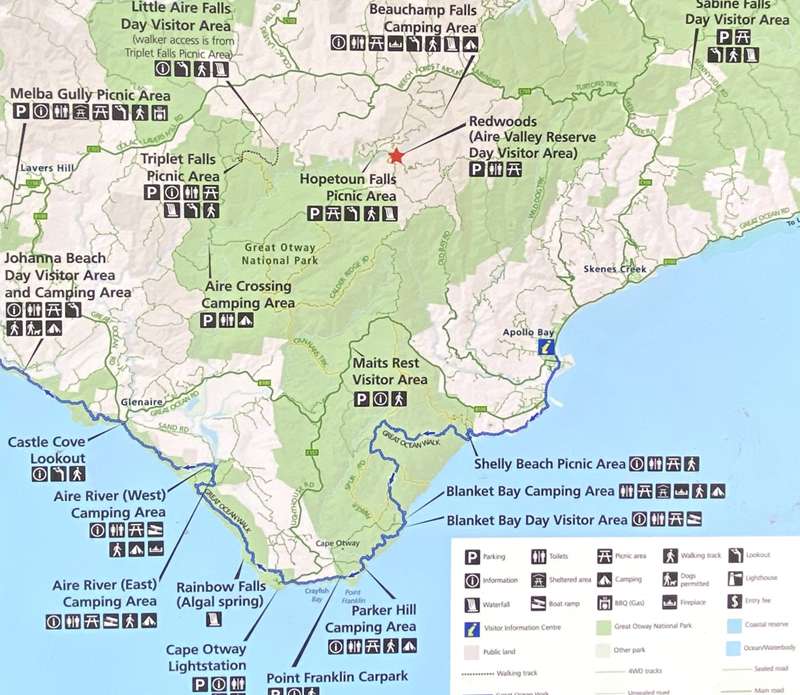
Otway Attractions Map
Photos:
Location
The Redwoods Otways, Binns Road, Beech Forest 3237 View Map
Web Links
→ Redwoods of the Otway Ranges (Wikipedia)


